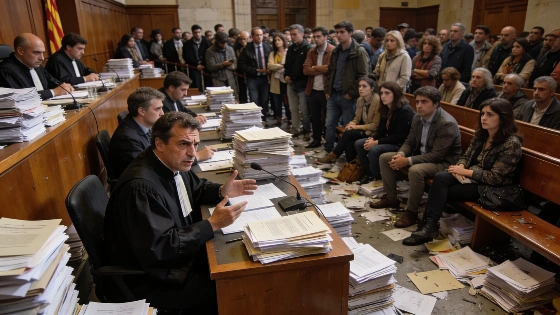
Barcelona's civil courts are overwhelmed by a surge in unresolved cases and a critical lack of judges. Delays for civil rulings now stretch up to four years, raising concerns for residents and legal professionals.
The civil chambers of the Audiencia de Barcelona are experiencing an unprecedented crisis, with unresolved cases piling up and a severe shortage of judges pushing delays for civil rulings to historic highs. In 2025, the number of new cases soared to 27,869—over 5,000 more than the previous year—setting a new record for the court. Despite the efforts of magistrates, only 18,141 cases were resolved, leaving more than 40,000 matters pending or in process. This backlog means that, even if no new cases were filed, it would take over two years to clear the current queue.
Antonio Recio, president of the Audiencia de Barcelona, has publicly warned that the civil sections are now facing waits of up to three years for a ruling, and he predicts this could reach four years in 2026. Recio attributes the worsening congestion to a sharp rise in consumer litigation, particularly disputes involving financial institutions, such as loan contracts, credit card agreements, and abusive clauses. However, he emphasizes that the core issue remains the chronic lack of judges. The government has announced eight new judicial positions for Barcelona's civil courts, but Recio insists that at least 16 are needed to address the crisis.
The scale of the problem is stark: the volume of cases per judge in Barcelona is nearly triple the official workload standard of 200 cases per year, as set by the Boletín Oficial del Estado. Even so, judges are resolving 65% more cases than the recommended limit. Recio notes that the total journey of a civil case, if it proceeds to the Supreme Court, can now stretch to 12 years—one to two years at first instance, three years at the Audiencia, and up to seven years at the Supreme Court.
Efforts to reduce the backlog have so far focused on limiting the influx of new cases. The government has introduced Alternative Dispute Resolution mechanisms (MASC), but these measures are still in their early stages and will require at least two years to prove effective. Recio has called for broader use of out-of-court settlements, especially for financial disputes, to ease the pressure on the courts. Other common issues clogging the system include evictions and claims for unpaid invoices, often complicated by interest calculations.
Catalonia faces an additional challenge: a systemic deficit of judges and high turnover rates. Many new judges, after completing their training at the Escuela Judicial, quickly leave their initial postings in Catalan regions for more desirable positions elsewhere, causing further delays as replacements must familiarize themselves with ongoing cases. This instability compounds the existing backlog and makes it even harder to deliver timely justice.
While the crisis in Barcelona's civil courts is particularly acute, similar strains have been reported in other parts of Spain, reflecting a broader challenge for the country's judicial system. The situation echoes the kind of systemic pressures seen in other public services, such as the recent disruptions caused by extreme weather in Madrid, highlighting how resource shortages and rising demand can quickly overwhelm essential institutions.
For context, Spain's judiciary has long struggled with underfunding and staffing gaps, especially in major urban centers. The introduction of digital case management and alternative dispute resolution methods is ongoing, but experts caution that without a significant increase in judicial appointments and administrative support, delays are likely to persist. The current crisis in Barcelona serves as a warning sign for the need to prioritize investment in the justice system to ensure timely access to legal remedies for all residents.