Free concerts will bring symphonic and band music to Nou Barris. The Museu de la Música will add workshops, exhibitions and heritage events, while a new arrangement of Els segadors receives its first performance.
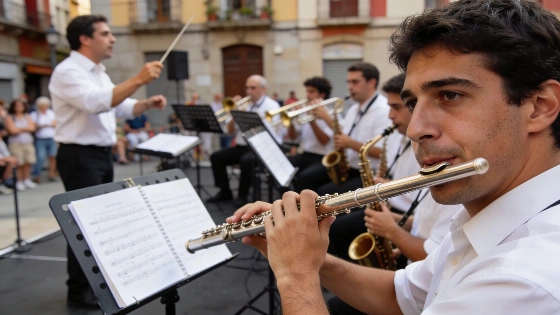
A new arrangement of Els segadors will receive its absolute premiere in Barcelona during La Mercè. Bernat Vivancos wrote the version for band. The Banda Municipal de Barcelona will perform it on Saturday 26 September at Plaça Major de Nou Barris. The programme pairs Catalan music and new work with pieces linked to Pau Casals.
The concert is part of the festival Lletres al vent. It starts at 20.45 h under the direction of José R. Pascual-Vilaplana. The programme also includes Suite Furera by Marc Migó and Per la flor del lliri blau by Joaquín Rodrigo. It will feature Peace, Peace, so Sing the Birds (Pau, pau, així canten els ocells) by Yasuhide Ito as a tribute to Pau Casals.
La Mercè 2026 runs from 23 to 27 September and includes 109 free concerts across 16 venues in Barcelona.
Two sardanas will close the concert: Sant Martí del Canigó by Casals and Heroica by his brother Enric Casals.
The same square will host the Orquestra Simfònica de Barcelona i Nacional de Catalunya the evening before. The OBC performs at 20.45 h on Friday 25 September under the baton of young Portuguese conductor Miguel Sepúlveda.
Its programme connects symphonic music with dance and popular tradition. The concert opens with the Danzas polovtsianas from El príncipe Ígor by Aleksandr Borodín. It then moves to the Danzas rumanas by Béla Bartók, which draw on Transylvanian melodies. Sepúlveda will finish with a selection from El lago de los cisnes by Piotr Ilich Chaikovsky.
The festival’s wider programme comprises 235 cultural events: 109 concerts, 55 culture popular performances and 180 street shows. Events are distributed across Barcelona’s ten districts, reinforcing the citywide character of La Mercè.
Both performances are free and bring large orchestral and band works beyond L’Auditori. For Nou Barris residents, the practical point is simple. The two concerts take place outdoors in the same central location on consecutive evenings. La Vanguardia’s guide to La Mercè 2026 presents the spread across neighbourhoods as a central part of the festival, not as a one-off outdoor event.
The Museu de la Música will add more to the festival than stage performances. On Thursday 24 September, it will open from 10 to 21 h. Admission to the permanent collection and temporary exhibitions will be free. Commented visits are scheduled for 11 h, 12.30 h and 17 h. The museum is also part of the wider programme of free open-door cultural activities reported in festival guides.
That day will also see the first presentation of Els colors del so. The workshop explores sound through the educational instrumentarium created by the Baschet brothers. Jordi Casadevall will lead it. It is especially recommended for children over five and will take place at 10.30 h and 12 h.
The museum’s programme continues on Saturday with the study day Ricard Viñes i el seu temps. It was organised for the 150th anniversary of the pianist’s birth. The event is linked to the exhibition Ricard Viñes a París. Diari d’un pianista, which can be visited until 11 October.
The study day includes a presentation on the Érard pianos preserved at the Museu. It also features a concert-lecture by Luca Chiantore, a round table on Viñes and his cultural context, and a guided visit to the exhibition. At 19 h, pianist Pedro López Salas will perform works by Soler, Chopin, Haydn and Liszt in collaboration with AIE-Clásicos en Ruta.
Nou Barris is hosting more than the two headline concerts. Independent programme listings place the Cor del Gran Teatre del Liceu in the same square on 24 September. The OBC follows on 25 September, the Banda Municipal de Barcelona on 26 September, and Vozes with Marco Mezquida on 27 September. The schedule helps explain why the district has become one of the main musical centres of this year’s festival.
La Mercè offers more than a run of free concerts. The OBC brings international symphonic repertoire. The BMB gives Els segadors a new form for band and puts Catalan creation at the centre of its programme. The Museu de la Música adds access to collections, workshops, research and a recital. Together, these events make the festival’s music heritage programme one of its largest strands. They link live performance with education and preserved instruments, with no admission charge.