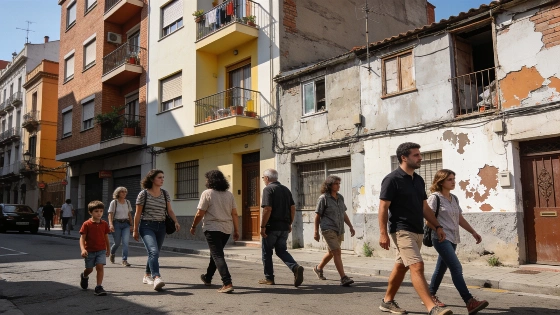
Barcelona’s metropolitan region is seeing rising prosperity and diversity, but territorial and social inequalities remain entrenched. New data reveal widening gaps in income, housing, and child poverty across the area.
Barcelona’s metropolitan area, home to 3.5 million people across the capital and 35 surrounding municipalities, is experiencing significant demographic and economic shifts. While average income and employment rates have improved, the latest figures from the Institut Metròpoli highlight persistent and, in some cases, worsening inequalities between neighborhoods and population groups.
The annual report 'El AMB en cifras 2026. La Metrópoli en 100 indicadores' shows that, despite overall progress, the region’s share of Catalonia’s population has dropped from 47% to 42% over the past two decades. The area is also aging rapidly: there are now 160 residents over 65 for every 100 under 15, compared to 131 two decades ago. At the same time, the foreign-born population has surged, now representing 21.3% of residents, up from just 3.5% in 2000. In the last three years alone, 150,000 new foreign residents have arrived annually.
Income disparities remain stark. The average annual income per consumption unit in the metropolitan area has risen from €19,987 in 2016 to €26,864 in 2024. However, this average masks deep divides: Barcelona city stands above the mean at €28,493, while affluent municipalities like Sant Cugat del Vallès and Sant Just Desvern approach €40,000. In contrast, Santa Coloma de Gramenet and Badia del Vallès fall below €19,000. The Besòs river corridor is especially affected, with six out of nine municipalities with high vulnerability located there.
Child poverty is a growing concern, now affecting 31% of minors—up from 26% a decade ago. The risk of poverty among migrants has reached 40%, and severe poverty impacts nearly 10% of the population. Rising inflation in food, utilities, and housing has hit the lowest-income households hardest, deepening their vulnerability.
Housing trends have shifted notably. In Barcelona, the proportion of renters has climbed from 38.2% in 2017 to 43.6% in 2024, while homeownership has dropped. This shift has coincided with a crisis in affordability: nearly 30% of renters now spend over 40% of their income on rent. The director of Institut Metròpoli notes that housing, more than the labor market, has become the main driver of inequality, with wealth increasingly transferred from low-income tenants to affluent property owners.
Residential mobility is also on the rise, with forced moves due to economic reasons increasing from 6% to 24% over two decades. Demand for public housing is surging: in 2025, 48,549 people were registered in Barcelona, up 17% from the previous year, and 31,825 in the wider metropolitan area, a 24% increase.
Environmental indicators show some progress. Nitrogen dioxide pollution has dropped 37% and PM10 particles by 13% in the last decade, mainly due to a modernized vehicle fleet. However, current pollution levels still exceed the EU’s 2030 targets and World Health Organization recommendations. Waste generation per capita has fallen 18% over 20 years, and recycling rates have doubled to 40%, though still below the Catalan average of 56%. Water consumption has decreased by 25%.
Mobility patterns remain stable: 75% of daily trips are made by walking, cycling, or public transport, with private cars accounting for 24%. Notably, hybrid and electric vehicles now make up over half of new registrations, a dramatic rise from just 1.5% in 2015.
These findings come as the region faces mounting pressure to address entrenched inequalities. While Barcelona city can redistribute resources thanks to its strong fiscal base, many surrounding municipalities lack the means to balance disparities on their own. Experts argue that only coordinated metropolitan or Catalan-level policies can effectively target the most vulnerable zones.
Recent extreme weather events have also tested the region’s resilience. For example, violent storms in southern Valencia have highlighted the importance of robust infrastructure and social support systems, issues that are increasingly relevant as Barcelona’s metropolitan area continues to evolve.
Barcelona’s transformation reflects broader trends seen in major European cities: growing diversity, rising prosperity, but also sharper divides. The challenge for policymakers will be to ensure that future growth benefits all residents, not just the most privileged neighborhoods.