Benidorm’s council has greenlit a major renovation of its bullring into a cultural hub. Meanwhile, the Generalitat launches a €50 million international competition to redesign the city’s seafront, with unresolved demolition orders for two towers.
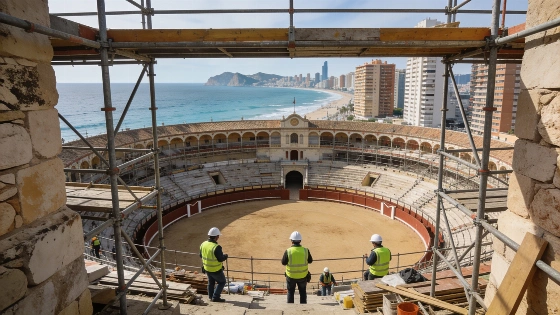
Benidorm’s city council has formally awarded the contract for the transformation of its long-dormant bullring, marking a significant step in the city’s urban renewal. The €13.87 million project, granted to a consortium of Gestaser, Urdecon and Plaza de Toros, will see the 1962 arena—unused for years and now mostly a storage site—reborn as a multifunctional cultural and youth centre. The decision passed with support from PP and Vox, while PSOE abstained.
The overhaul is part of the broader Plan EDIL and will be 60% co-financed by EU Feder funds from the 2021–27 period. The works include not only the structural rehabilitation of the bullring but also the creation of a versatile youth centre and improved urban links, especially connecting the Els Tolls neighbourhood with the rest of Benidorm. The council’s spokesperson, Lourdes Caselles, defended the joint tender for design and construction, citing technical advice that this approach would better manage the building’s structural complexity and streamline timelines.
In parallel, the Generalitat has announced a high-profile international competition to complete the closure of Benidorm’s seafront. With a total investment of €50 million, the contest will allocate €3.8 million for the winning design, which must deliver architectural excellence, landscape integration, urban quality, sustainability and technical feasibility. The selected team will be responsible for drafting the project, conducting the environmental impact study and overseeing construction. Runners-up will receive €30,000 and €20,000 respectively. Authorities expect to launch the competition before year-end, with a three-month window for submissions and a winning proposal chosen by early 2027.
One of the most contentious issues remains the fate of the Gemelos 28 towers—two 21-storey buildings with 256 apartments—ordered for demolition by court rulings. The Supreme Court ruled in 2012 that their construction violated coastal protection laws, a decision upheld by the Valencian High Court in 2017, which specified that new buildings could only be erected further inland. Despite a proposal sent to the Ministry in March, the Generalitat says it has yet to receive a response, leaving the legal and urban future of the site unresolved.
The seafront project aims to create a continuous pedestrian promenade along the entire bay, enhancing the connection between city, landscape and sea. Officials hope the new design will set a benchmark for coastal architecture and urban regeneration in the region. The initiative is seen as one of the most ambitious of its kind in the Comunitat Valenciana, with the Generalitat seeking to attract top international talent for the task. The move follows a series of high-profile urban interventions in the area, including recent archaeological discoveries near Alicante’s beaches, as highlighted in reports such as the unearthing of a Roman Venus head during local construction works.
Benidorm’s bullring, once a major venue with a 10,000-person capacity, has not hosted events for years due to its deteriorated state. The planned transformation is expected to breathe new life into the structure and surrounding neighbourhoods, while the seafront competition could reshape the city’s image for decades. The outcome of the Gemelos 28 dispute remains a key factor in the final design and legal certainty of the coastal redevelopment.
Benidorm is one of Spain’s most visited tourist destinations, known for its high-rise skyline and Mediterranean beaches. Urban renewal projects like these are increasingly common in Spanish coastal cities, reflecting both the challenges of legal disputes over land use and the drive to modernise public spaces. The combination of EU funding and international design competitions is becoming a preferred model for large-scale urban interventions across the country.