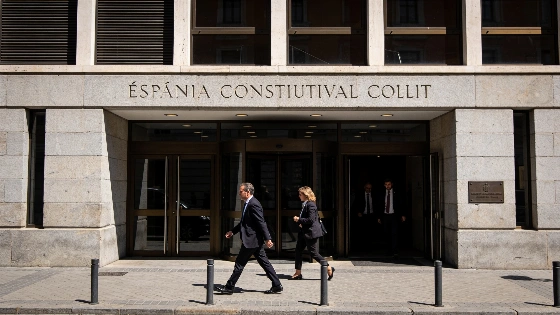
Justice Minister Félix Bolaños is pushing back against the Supreme Court’s freeze on voting rights for 400,000 Spaniards who gained citizenship through the law of grandchildren. He wants a quick answer, warning that democracy is at risk.
Félix Bolaños did not hold back. The Justice Minister went on Cadena SER and called out the Supreme Court for blocking voting rights for thousands of new Spaniards. He said 400,000 people have lost their chance to vote in the next elections. Bolaños wants the court to make a final decision now. He says the stakes are too high for Spanish democracy to wait.
“I believe the Supreme Court, now that elections are called and a precautionary measure is in place, should resolve the substance of this matter as soon as possible,” Bolaños said. Many of those affected have already voted in Spanish elections. The law has been in place since 2008, after the Zapatero government’s memory law. But the State Attorney's Office has different numbers. As of August 31, 2026, only 168,896 people were actually on the CERA register of non-resident voters under the disputed exile presumption. This rule came from a 2022 instruction by the Ministry of Justice. The Supreme Court’s freeze targets this specific group, not everyone who got citizenship through the "law of grandchildren."
By June 2026, the Ministry of Territorial Policy reported that 544,722 people had obtained Spanish citizenship under the Law of Democratic Memory, but this figure includes minors and those not registered in the CERA electoral roll.
Bolaños called the court’s move a blow to basic rights. He said the suspension “has deprived 400,000 people of the right to vote.” The scale is huge. He also said the process for these voters had worked “with absolute normality” until now. Bolaños blamed the uproar on what he called a “hoax” spread by right-wing and far-right groups. The numbers tell a different story. Not all naturalized citizens can vote. Only adults on the CERA list are eligible, a point the Ministry of Territorial Policy keeps stressing.
For Bolaños, this is about more than legal details. He says denying the vote to Spanish citizens is a serious step. The country needs answers, fast. The debate comes as Spain faces tough questions about who counts as a citizen and who gets a say at the polls. These fights echo other recent legal battles over voting rights and government actions, like the Ceuta border crisis investigation. Official statements show that on September 8, the Supreme Court temporarily blocked the inclusion in CERA of those who got nationality under the "law of grandchildren"—unless they can prove descent from people exiled for political, religious, or sexual orientation reasons. The court is now checking if the way these cases were handled followed the law.
The government’s message is simple. The right to vote for these new Spaniards cannot stay in limbo. Bolaños wants a quick fix. He says the integrity of Spain’s elections is at stake. The court’s next move will show if it can act fast and if Spain’s democracy can hold up under pressure. The clock is ticking. Early elections are set for November 29. The court has given parties just 48 hours—until 3:00 p.m. on October 8—to file objections before it decides whether to keep the freeze.
By May 31, 2026, consulates had received 1,225,188 applications under the law, approved 571,761 cases, and made 333,696 registrations in consular records. These figures reflect different stages of the process and cannot be directly equated to the number of eligible voters.