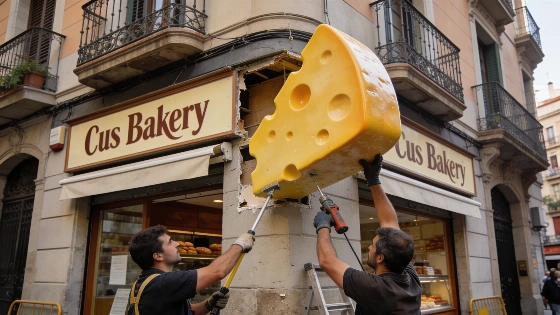
Boom Cake, a new bakery on Consell de Cent in Barcelona, has taken down its striking giant yellow cheese sign following a city inspection and neighborhood criticism. The removal came before the shop opened, after the Barcelona City Council determined that the facade breached urban field regulations. The business faces official proceedings over the unauthorized installation and an order to restore the building’s exterior.
The bakery’s owners, responding on social media, emphasized that they never intended to provoke controversy. They expressed hope that Boom Cake would eventually be recognized for its food rather than for a dispute over its appearance. The shop plans to offer Japanese cheesecake and specialty coffee, along with matcha, and had drawn attention even before opening because of its bold design choices.
The sign dispute has unfolded alongside wider scrutiny of commercial activity on Consell de Cent. Municipal inspectors detected in July that Boom Cake was operating without the relevant activity licence, and the district opened an administrative file. Municipal sources told La Vanguardia that the case was proceeding through the usual deadlines. The reporting links the episode to Barcelona’s enforcement of commercial and urban-field rules amid rapid business turnover.
Local neighborhood associations have interpreted the oversized cheese motif and vivid yellow facade as another sign of Consell de Cent’s change. Residents have voiced concerns about the loss of traditional local businesses and their replacement by venues catering to tourists and other non-local customers, including brunch spots and specialty cafés. The controversy sits within a wider debate over Barcelona’s commercial moratorium and what ERC councillors describe as commercial monoculture; they have urged Mayor Jaume Collboni’s administration to strengthen controls.
The political debate also touches on the treatment of established businesses. Elisenda Alamany is ERC’s secretary general and spokesperson, and her party is involved in discussions about Barcelona’s urban model and neighborhood commerce. Separately, the City Council and the owners of Bodega Carol have sought to suspend litigation over the bodega’s sign while exploring ways to protect commercial features with historical or heritage significance. Municipal sources said the proposed work would involve consultation with the commercial sector and the reactivated Mixed Advisory Commission on Urban Field, followed by a future amendment to the Urban Field Ordinance.
The Bodega Carol case reflects how the city’s field rules can affect even long-standing signs: information from La Vanguardia, that sign exceeded the applicable requirements by only a few centimetres. Municipal technicians had also ordered Bar Fermín in Barceloneta to remove a projecting corner sign that had been in place since the 1970s. These cases have sharpened debate over how enforcement should balance the rules governing commercial façades with the preservation of distinctive neighborhood landmarks.
Boom Cake’s management has distanced itself from the broader debate, saying the design was meant to catch the eye and bring a smile, not to make a cultural statement. The owner highlighted the entrepreneurial nature of the project, describing it as a personal venture rather than part of a large chain. The focus, they said, remains on crafting quality pastries with care and dedication.
Barcelona’s urban-field rules govern commercial signage and façade changes, placing business design within a broader effort to shape the city’s public spaces. Boom Cake’s case brings that regulatory role into focus as the city also considers how to recognize historically or patrimonially distinctive features. The two debates raise different questions: a new shopfront and a long-standing heritage sign may fall under the same ordinance, but have different histories and policy considerations.