Brussels wants emergency teams across Europe to stay connected when borders or blackouts disrupt terrestrial networks. The proposal combines satellites, 5G and European-made critical components.
Police, firefighters and medical teams could share messages, photographs and geolocation data across borders through a proposed European network. Civil protection units would use the same structure when terrestrial systems fail. Its hardest test could come during disasters, infrastructure attacks, terrorist attacks or a blackout like the one Spain experienced last year.
The plan is not an operating system. It is a Commission proposal for a gradual rollout. Emergency communications would get priority when public networks become overloaded or stop working.
The IRIS² satellite constellation, already under development, is being considered as a possible European fallback for the emergency communications network when terrestrial infrastructure or internet services fail.
Brussels also wants the project to support European strategic autonomy. European companies would be expected to supply critical components for satellites, mobile networks and broadband infrastructure under a wider "Made in Europe" approach.
The goal is to reduce reliance on suppliers outside the European Union. Those suppliers could become decisive when ordinary communications collapse.
The proposal has an industrial side, too. The network would connect emergency agencies and put more of the hardware behind those links under European control. The Commission ties operational resilience to the supply of satellites, mobile systems and other communications infrastructure.
The move is part of a wider European shift from legacy narrowband radio systems toward LTE and 5G-based mission-critical services. Ericsson has reported testing and deployment work for emergency-service communications in Europe, illustrating how broadband technologies are being adapted for operational use.
Satellites would provide the fallback when land-based networks go down.
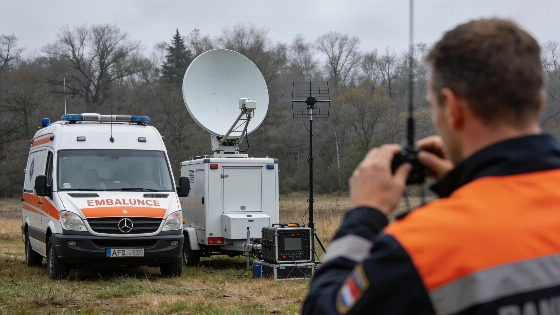
The Commission also wants existing narrowband radio systems to move toward broadband technologies such as 5G. European satellite systems would support emergency links. Emergency units could use satellite communications and dedicated communication units when terrestrial infrastructure is unavailable.
Mission Critical Services would carry voice, video and data securely over mobile broadband. The European Commission says this combination could preserve communications when networks are overloaded, damaged or disconnected.
The architecture would have two European centres. The EU Network Monitoring Centre would connect national networks through a fibre-optic network. The EU Security Monitoring Centre would assess cybersecurity risks and threats.
Together, the centres would give the system a shared operational and security layer. Each country would not have to manage cross-border links alone.
The timetable is staged. An initial group of countries is expected to join in 2030. Other states would take part progressively in 2033 and 2036.
This is a long-term infrastructure project. It is not an immediate replacement for national emergency networks. EU member states and the European Parliament must still agree to the plan before implementation.
The approach fits a wider Brussels preference for linking national measures to common European requirements. An earlier housing report about European funds and unfinished reforms showed the same pattern in a different sector.
Here, the practical problem is direct. Emergency teams may need to communicate across borders after ordinary networks stop working.
The proposal puts communications resilience and industrial independence on the same track. Its value will depend on whether national systems can connect and whether European suppliers can provide the required components.
For now, it remains a plan. The staged adoption has not begun. The weakness it targets is clear: emergency services cannot coordinate reliably when the communications infrastructure beneath them fails.