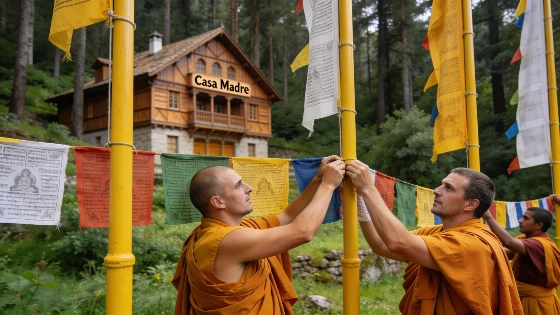
Chu Sup Tsang monastery in San Amaro, Ourense, has reopened after a devastating fire in 2024. The site now enters a growth phase, with new meditation cabins planned in the forest. Community support and rapid rebuilding have marked its recovery.
After a catastrophic fire in February 2024 nearly destroyed the main building of Chu Sup Tsang, Galicia’s first Buddhist monastery, the site in San Amaro (Ourense) has reopened and is preparing for a new phase of expansion. The blaze, which started in the wood chimney, consumed the 400-square-metre Casa Madre, destroying wooden beams, sacred texts, and ritual objects. Despite the scale of the loss, the monastic community quickly mobilized to rebuild, seeing the disaster as an opportunity to clear the way for renewal.
Donations from around the world, ranging from small coins to significant contributions, poured in after the fire. Insurance covered about 60% of the reconstruction costs, while the expertise of resident monastics—such as Tenzing Palmo, a former architect from A Coruña, and Tenzing Ngeyung, an experienced international aid worker—helped accelerate the process. Enhanced safety measures were introduced to prevent future incidents.
The reopening at the end of July drew around 300 attendees, including Buddhist authorities and visitors from Asia. The event featured a forest conference by Gueshe Tenzing Tamding, the monastery’s founder and director, and a communal meal for 170 disciples. With the restoration of the Casa Madre’s dormitories, philosophical activities resumed in August, starting with a week-long retreat for 60 participants. The monastic community, which includes figures like Tenzing Lobsang—a former Malaysian pop singer—and Ghen Dakpa Metruk from Tibet, worked intensively to prepare the site for the relaunch.
In the days leading up to the reopening, efforts continued at a frenetic pace. Monastics sourced pine bark to cover machine-scarred earth, bought affordable flowers to decorate the entrance, and transformed an old shed into the Shiné Café, despite a missing accent on the sign. The final touches included hanging Tibetan fabric doors and thangkas, and installing 52 yellow-painted iron flagpoles for thousands of prayer flags, each bearing the names of retreat families. This tradition, known as lungta or “wind horse,” is believed to spread positive energy across the universe.
With the Casa Madre restored, Chu Sup Tsang is now entering a planned growth phase. The first step, expected by 2027, is the installation of ten fully equipped wooden meditation cabins in the surrounding forest, each between 27 and 42 square metres. Longer-term plans include a large gompa (meditation hall) and a stupa, though these depend on the monastery’s finances. The site, covering 35,000 square metres, is set to become a major reference point for Buddhist practice in northwest Spain.
The rapid recovery of Chu Sup Tsang stands out in a region where fire risk remains a pressing concern. The challenges faced by firefighters and communities in Spain have been highlighted in recent years, as seen in reports on critical shortages and wildfire impacts in areas like Castilla y León. For example, fire services in Castilla y León have struggled with staff shortages and outdated equipment, underscoring the broader vulnerability of rural and spiritual sites to such disasters.
Chu Sup Tsang’s story reflects both the resilience of its community and the ongoing need for vigilance and adaptation in the face of natural threats. The monastery’s revival, driven by local and international support, has allowed it not only to recover but to look ahead to new projects and a strengthened presence in Galicia’s spiritual landscape. As the site welcomes visitors and prepares for further development, it stands as a symbol of renewal and collective effort in the aftermath of crisis.