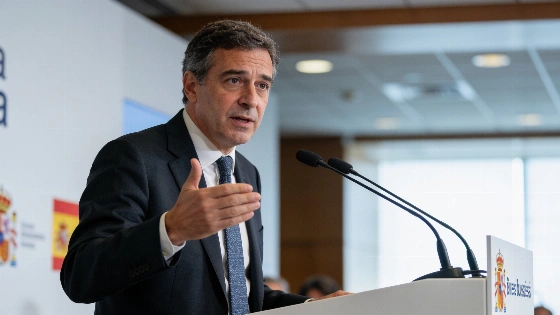
Pablo Bustinduy used the CREO forum’s second day to press for fairer taxes and higher pay. He warned that corporate concentration and rising wealth at the top are weakening redistribution and consumer bargaining power.
INE data published in May 2026 put Spain’s average annual gross pay at €29,540 in 2024. Median pay was €24,497, while 25.7% of the population faced a risk of poverty or social exclusion.
At the CREO forum in Spain on Thursday, Pablo Bustinduy called for a fairer tax system and higher wages. The minister for Social Rights, Consumer Affairs and Agenda 2030 said the richest 10% are accumulating a larger share of the country’s wealth as listed companies and banks report record profits.
He argued that tax policy has failed to redistribute wealth and urged businesses at the event to raise pay. A study by the Instituto Juan de Mariana, cited by Euronews, estimated that taxes and social contributions amounted to €53.60 for every €100 in average employer labour costs in 2026. Research director Diego Sánchez de la Cruz put average annual labour costs at €39,481, including €21,144 in taxes and contributions.
Bustinduy also described housing as a way of extracting income from workers. In his account, corporate concentration has increased companies’ market power, while consumers remain scattered individuals whose main influence is choosing what to buy. Over the past decade, asking prices for homes in Spain rose by about 90%, and average rents nearly doubled, according to figures cited by France 24 from Idealista. Banco de España estimates a housing shortfall of around 700,000 units.
That imbalance was the central economic argument of his intervention. Bustinduy said wealth concentration makes effective equality harder to achieve. Between 2022 and 2024, median net wealth fell by 4.3% among the bottom 20% of households by income and rose by 26% among the top 10%, according to an analysis of Banco de España data. INE figures in the same report show the Gini coefficient for income falling from 33.2 in 2018 to 30.8 in 2025. The income ratio between the top and bottom fifths declined from 6.0 to 5.2. The forum’s second day is examining who is affected by the forces shaping the economy.
Healthcare offered a clear measure of pressure on public services.
Fernando Campos, chief executive of DKV Seguros, said people aged over 65 could account for nearly 30% of the population by 2050, compared with 20% today. Chronic diseases already account for eight out of every ten euros of healthcare spending.
Campos called for a shift from treating illness towards prevention and care, with the aim of protecting people’s autonomy and quality of life. He backed stronger public-private cooperation and said artificial intelligence could help anticipate illness, freeing clinicians to spend more time with patients. He stressed that AI should support medical staff rather than replace doctors. The focus on prevention sits alongside the CIS October poll, which reported housing disputes as a feature of the election campaign.
Paradores president Raquel Sánchez set out a different public-service challenge: maintaining hotels that preserve heritage and support smaller destinations. She said 70% of the network’s properties are in towns with fewer than 35,000 residents. A €300 million investment plan is intended to renovate up to 60% of its facilities. Sánchez said the public company’s rising profitability allows returns to benefit the wider public.
The forum also includes Labour Minister Yolanda Díaz. Inclusion Minister Elma Saiz and Deputy Prime Minister Sara Aagesen are on the programme, alongside business leaders and public officials. On the first day, speakers described the Spanish economy as solid while pointing to geopolitical risks. They also raised technology and housing access. Ricardo de Querol, director of CincoDías, argued for recognising that strength without overlooking structural problems such as the difficulty of finding housing. In Madrid, average rent for a 50-square-metre apartment reached €1,170 a month in September 2026, about half the average gross salary, France 24 reported, citing Idealista.
The programme is due to close with conclusions from de Querol at around 18:30.