Catalan Authorities Expedite Construction of New Medical Campuses in Barcelona and Girona. The Catalan government has granted priority status to two major healthcare projects. This decision will speed up construction of the new Clínic hospital in Barcelona and a campus in Girona. Both facilities are expected to play a key role in strengthening the region's healthcare system.
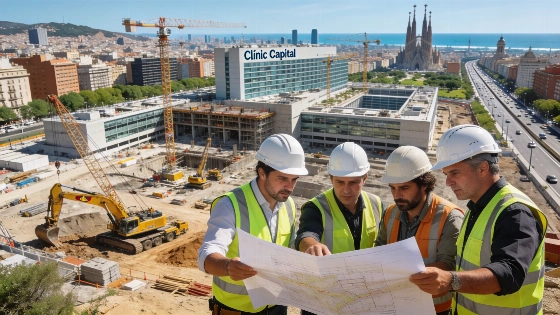
The Catalan authorities have decided to give top priority to the construction of two large-scale medical facilities: the new Clínic-Universidad de Barcelona campus and the health campus in Girona. The corresponding resolution will be approved at the next government meeting, allowing for the acceleration of all approvals and the removal of some bureaucratic barriers to the implementation of the projects.
As explained by the advisor to the presidency Gerard Dalmau, these are strategic initiatives aimed at transforming the region's healthcare, education, and scientific research systems. Both projects have separate timelines: the campus in Girona will begin first, followed by the new Clínic complex in Barcelona. Both facilities are intended to strengthen Catalonia's position as one of Europe's leading centers in the fields of medicine and biosciences.
Assigning the status of a project of national interest will give these initiatives priority in obtaining permits for connection to power grids and allocation of capacities, which is especially important for large medical and research institutions. In addition, the government will confirm the transfer of land plots on Avenida Diagonal, previously owned by the University of Barcelona, for the construction of the new Clínic campus. The purchase agreement for these lands, worth 135 million euros, was already signed earlier this year.
The future campus will bring together a new hospital, the UB Faculty of Medicine and Health Sciences, as well as additional facilities for education, research, and medical care. The total area of the complex will be 300,000 m², allowing Barcelona to become one of the world's largest biomedical hubs. A preliminary announcement of the international project competition has already been published, with the launch set for autumn. In the first stage, from September to November, teams will submit their applications and technical documentation. This will be followed by two selection rounds: first, 10 teams will develop concepts by April 2027, after which 5 finalists will prepare detailed proposals by December. The winner will be determined in the first quarter of 2028 and will receive a contract worth 134 million euros.
Only multidisciplinary teams with experience in architecture, engineering, sustainable development, medical equipment, and energy efficiency may participate. The jury will include architects, engineers, representatives of CatSalut, and more than 35 technical and institutional experts. The project envisions creating a mixed urban environment with housing, green spaces, infrastructure, and economic activity related to the life sciences. Special attention is given to transport accessibility, including a new Line 3 metro station and upgrades to the road network.
According to the government, three key steps—the designation of the projects as matters of national interest, land transfer, and the publication of the tender announcement—should ensure the campus opens in 2035, with total investments of around €1.7 billion.
The Project in Girona
The winner of the architectural competition in Girona has already been selected: the consortium PINEARQ, SLP & Brullet de Luna, and PEGI Engineering will design the campus named Devesa de Salut 21. After signing the contract, the team will have two years to prepare all project documentation. The new campus will be located between Girona and Salt, bringing together the Doctor Josep Trueta University Hospital, educational and research spaces, and an innovation center for medical companies supported by the University of Girona.
The complex is planned to cover 175,000 m², of which 130,000 m² will be dedicated to infrastructure and the remainder to green areas. The total permitted construction area is up to 320,000 m². The new hospital is expected to occupy 170,000–175,000 m², with an additional 50,000 m² from the existing Hospitalari Martí i Julià park. Nearly 60,000 m² will be designated for educational and research purposes, while over 80,000 m² are reserved for future expansion.
As a result, the number of operating rooms will increase from 19 to 31 (or 33, with a reserve), and the number of specialized rooms will rise from 12 to 18 (or 24). The hospital capacity will grow from 674 to 791 beds, with the potential to expand to 855, and the number of emergency department cubicles from 84 to 136 (or up to 162 at maximum capacity).
Alongside these changes in the Catalan healthcare system, other regions of Spain are also engaged in debates over priorities and funding for social projects. For example, in Valencia, discussions are underway about the pressure on charitable organizations providing assistance to migrants, as highlighted in the article regarding the situation surrounding support for migrants provided by Cáritas Valencia.
For reference: Catalonia has traditionally been a leader in Spain in terms of investment in healthcare and scientific research. In recent years, the region has been actively developing infrastructure for medical clusters, enabling it to attract international teams and strengthen its position in the European biotechnology market. The new campuses are expected to drive growth and create additional jobs in the sector.