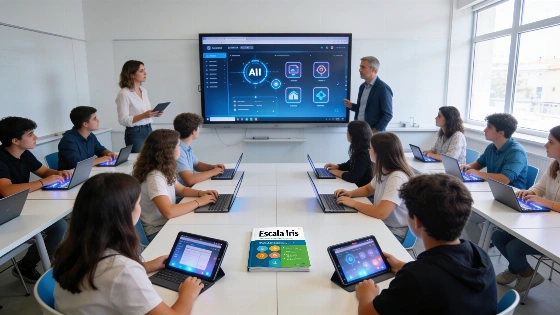
The Escola Cristiana de Catalunya has released a guide to help schools manage AI use. The document outlines six levels of AI involvement in learning. The focus is on transparency, not prohibition.
Schools across Catalonia are preparing for a new era in education as the Fundación Escola Cristiana de Catalunya (FECC) introduces a comprehensive guide on the responsible use of artificial intelligence in classrooms. The initiative, unveiled this week, aims to ensure that AI tools are integrated transparently and thoughtfully, rather than being banned or left unchecked.
The FECC's new guide, presented by secretary general Meritxell Ruiz, emphasizes that the debate is not about whether AI is inherently good or bad, but about how it should be used in educational settings. The organization insists that technology must serve a clear purpose and that the human role in learning should remain central. Rather than imposing restrictions, the guide encourages schools to reflect on the appropriate use of AI for each specific task.
Central to the guide is the 'Escala Iris,' a framework that categorizes AI use into six distinct levels. At level 0, activities are carried out without any AI involvement. Level 1, the most common in schools, uses AI for mechanical corrections, such as grammar checks or translations, without generating new ideas. Level 2 sees AI acting as a source of inspiration, suggesting ideas to students. At level 3, AI drafts initial versions of work, which users then review and verify. Level 4 introduces a collaborative process, where humans and AI engage in ongoing dialogue. Finally, level 5 allows AI to independently produce finished products, such as educational applications.
Miquel Àngel Prats, who coordinated the team behind the guide, clarified that the Escala Iris is not intended to police AI use but to promote openness about how these tools are applied. He noted that most students already use AI in some form, so the focus should be on understanding and discussing their methods, not on enforcement.
The guide provides practical examples for each level, illustrating how both students and teachers might interact with AI in different educational contexts. However, it stops short of prescribing which level is best for any given task. According to the authors, sometimes the absence of AI is preferable, while in other cases, advanced AI involvement can unlock new possibilities. The key, they argue, is ongoing reflection and adaptation.
Distribution of the guide is planned for all FECC-affiliated schools ahead of the next academic year. At the same time, the organization acknowledges the need for targeted teacher training to ensure staff are equipped to navigate the evolving landscape of AI in education.
This move comes as debates over technology and fairness in Spanish education continue to surface. For example, concerns about regional disparities in funding and resources have been highlighted in recent discussions, such as those raised by Castilla-La Mancha's leader regarding the national funding system. More details on these broader challenges can be found in this analysis of regional funding inequalities in Spain.
As AI becomes increasingly embedded in daily life, Catalonia's approach may serve as a model for other regions seeking to balance innovation with responsibility. The FECC's guide reflects a growing recognition that technology, when managed transparently and thoughtfully, can enhance rather than disrupt the educational experience.
Artificial intelligence is rapidly transforming education worldwide, prompting schools and policymakers to reconsider traditional teaching methods. In Spain, the integration of AI is still uneven, with some regions and institutions moving faster than others. The FECC's initiative highlights the importance of clear guidelines and ongoing dialogue to ensure that technological advances benefit all students. As the new school year approaches, the effectiveness of these measures will be closely watched by educators and families alike.