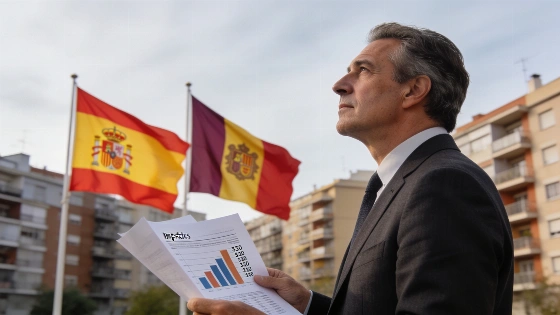
Emiliano García-Page criticizes Spain’s regional funding model, claiming it benefits wealthier regions and undermines equality. He warns that Castilla-La Mancha faces severe underfunding. The issue sparks new tensions within the PSOE.
Emiliano García-Page, president of Castilla-La Mancha, has sharply criticized Spain’s current system for financing autonomous communities, describing it as the most serious threat to equality since the country’s transition to democracy. He argues that the funding model, in its present form, systematically advantages the wealthiest regions while leaving others, including Castilla-La Mancha, at a significant disadvantage. According to García-Page, the region now risks becoming the worst funded in Spain, a situation he calls a grave attack on the principle of equal treatment among citizens.
García-Page’s remarks come at a time of heightened internal tension within the PSOE. He positions himself as a defender of the party’s core values, expressing concern that the leadership under Pedro Sánchez is eroding the party’s credibility. The president points to recent corruption scandals and controversial political alliances as factors undermining public trust. He also criticizes what he sees as a lack of self-criticism and courage among the party’s national leadership, warning that the current direction could have lasting consequences for both the PSOE and the country.
Beyond party politics, García-Page highlights the practical impact of the funding model on Castilla-La Mancha. He notes that the region, already underfunded, now faces even greater financial strain. This, he says, directly affects the ability to provide essential public services and maintain social cohesion. The president accuses the central government of trading away the fundamental value of equality, which he describes as sacred for any socialist, in negotiations that favor more affluent communities.
In the context of recent political developments, García-Page’s concerns echo broader debates about the balance of power and resources among Spain’s regions. The issue of regional funding has become increasingly contentious, especially as some communities push for greater autonomy and fiscal privileges. This tension is reflected in other recent events, such as the push for immediate implementation of the amnesty law in Catalonia, which has also stirred debate over fairness and legal consistency. For example, the recent call by Salvador Illa for swift application of the amnesty law, following a European court decision, has intensified scrutiny of how national policies affect regional dynamics. More details on this can be found in the report on Catalonia’s demand for rapid amnesty enforcement.
Turning to local governance, García-Page addresses the challenges faced by Castilla-La Mancha in managing wildfires. He reports that the region has experienced a particularly difficult year, with 140 more fires than in 2025. While most incidents were contained quickly, he acknowledges the increasing complexity of fire management, especially in the context of climate change. The president emphasizes the need for improved coordination with national authorities and enhanced prevention strategies to address future risks.
On a different note, García-Page also comments on the upcoming World Cup final, expressing strong support for the Spanish national team. He highlights the sense of unity and diversity represented by the squad, suggesting that such moments offer a positive counterpoint to the political divisions currently affecting the country.
Spain’s regional funding system, known as the modelo de financiación autonómica, has long been a source of debate. Established to ensure fair distribution of resources among the country’s 17 autonomous communities, the system is periodically renegotiated but often criticized for failing to address disparities. Regions like Castilla-La Mancha and Extremadura have repeatedly argued that the formula does not reflect their needs, while wealthier areas such as Madrid and Catalonia have pushed for greater fiscal autonomy. The ongoing disputes highlight the challenge of balancing national solidarity with regional interests—a debate that remains central to Spain’s political landscape in 2026.