Catalonia is urging the Spanish government to reintroduce highway tolls, arguing that rising traffic and accidents demand urgent action. The proposal aims to avoid regional disparities and fund road maintenance.
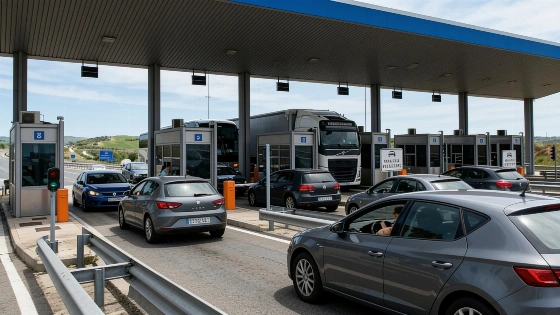
Manel Nadal, Catalonia’s Secretary of Mobility, has reignited the debate over highway tolls by openly advocating for their return—not just in Catalonia, but across all of Spain. In a recent interview on Cadena Ser, Nadal argued that the current system, which allows free passage on most national highways since September 2021, is unsustainable given the surge in traffic and accidents, particularly on the AP-7 corridor.
Currently, only a handful of expressways managed by the Catalan government require payment. However, Nadal warned that this could change within two or three years, as the region faces mounting pressure from congestion and a spike in road incidents. He emphasized that a unilateral return to tolls in Catalonia would be “incomprehensible” if the rest of Spain’s highways remained free, highlighting the need for a coordinated national approach.
Addressing Congestion and Safety
The Catalan government justifies its push for tolls by pointing to severe traffic jams and a rise in accidents, especially on the AP-7, one of the region’s busiest routes. According to sources from the Department of Territory, Housing and Ecological Transition, the current situation is costing lives, time, and economic competitiveness. Officials argue that tolls could help manage traffic flow, reduce accident rates, and generate funds for much-needed infrastructure upgrades.
One model under consideration is the Eurovignette, an electronic fee for vehicles over 12 tons, already used in parts of Europe. However, this system is set to be phased out by 2032, after which private vehicles may also face distance-based charges. Portugal’s satellite-based tolling system is cited as a technological benchmark.
For now, Catalonia’s traffic authorities are limited to temporary measures such as restricting overtaking, adjusting speed limits, and regulating driving hours to improve safety. But regional officials insist that only significant investment and bold decisions will address the underlying problems.
Funding Maintenance and Public Transport
Supporters of the toll proposal argue that the revenue would be earmarked for road maintenance and public transport improvements. They note that, since tolls were lifted, highways like the AP-7 have suffered from underfunding and deteriorating conditions. A dedicated payment system, they say, would ensure that funds are reinvested directly into the transport network.
Traffic data underscores the scale of the challenge: the AP-7 now handles volumes that are “no longer manageable,” especially for freight. While some measures can temporarily divert 2,000 to 3,000 trucks per day, the route through La Jonquera alone sees 15,000 trucks daily, with another 35,000 passing through the Vallès area. Officials stress that piecemeal solutions are insufficient and that a comprehensive strategy is needed.
Key Routes Targeted
If reintroduced, tolls would likely apply to major arteries such as the AP-2 (Madrid to Barcelona), AP-7 (linking Barcelona with Girona and Tarragona), the Eix Transversal, C-16 (Barcelona to Puigcerdà), C-14 (Salou to Seu d’Urgell), and C-12 (Amposta to Àger along the Ebro).
While the Catalan government frames the move as a matter of safety and sustainability, critics point out that Spain and its regions are already seeing record tax revenues, raising questions about whether new tolls are the only way to fund road maintenance.
For context, Spain’s shift away from tolls in 2021 was widely welcomed by drivers but has since led to increased congestion and maintenance challenges. Across Europe, countries are experimenting with various tolling models to balance mobility, safety, and infrastructure funding. The debate in Catalonia may signal a broader shift in how Spain approaches its road network in the years ahead.