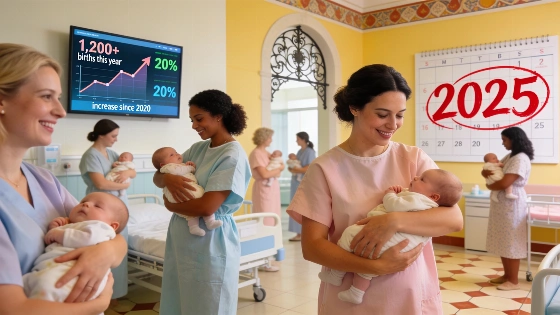
Births in Catalonia have increased for the first time in 17 years, reaching 54,249 in 2025. The average maternal age is now 32.8 years. Spanish nationals account for a growing share of new mothers, while foreign-born births decline.
For the first time since 2008, Catalonia has recorded an uptick in births, with 54,249 babies born in 2025, according to provisional figures from the Institut d’Estadística de Catalunya (Idescat). This marks a modest 0.8% increase compared to the previous year, breaking a long-standing downward trend in the region’s birth statistics.
The data reveals a notable shift in the profile of new mothers. The average age at childbirth has risen to 32.8 years, while women are now having their first child at an average age of 31.8. Both figures are higher than those reported in 2024, reflecting a continued trend toward later motherhood in Catalonia. Despite the rise in total births, the birth rate remains unchanged at 6.7 live births per 1,000 inhabitants, mirroring last year’s level. The number of women of childbearing age (15 to 49 years) has grown by 0.5% over the same period.
However, the overall fertility rate continues to decline, standing at 1.08 children per woman—slightly below the 1.09 recorded in 2024 and well below the 1.53 peak seen in 2008. This ongoing decrease underscores the demographic challenges facing the region, even as the absolute number of births edges upward.
One of the most significant changes is the growing proportion of births to Spanish nationals. In 2025, 65.3% of newborns had mothers with Spanish nationality, up 2% from the previous year. In contrast, births to foreign nationals fell by 1.2%, now representing 34.7% of the total. When considering mothers’ place of birth, 48.5% of babies were born to women native to Catalonia, 46.3% to women born abroad, and 5.2% to mothers from other parts of Spain.
Among foreign mothers, Moroccan women remain the largest group, accounting for 4,373 births—8.1% of all births in Catalonia and 23.2% of those to foreign nationals. Other prominent groups include mothers from Colombia (1,517 births), Pakistan (1,345), Honduras (857), and Peru (744). Italian nationals lead among mothers from European Union countries, with 740 births in 2025.
Popular baby names also reflect current trends. For boys, Biel, Nil, and Marc top the list, while Júlia/Julia and Sofía/Sofia are the most common choices for girls. These preferences highlight both local traditions and broader cultural influences in Catalonia’s naming patterns.
According to Idescat, the region’s demographic landscape is evolving. The combination of a slight increase in births, a higher average maternal age, and a shifting balance between Spanish and foreign-born mothers points to complex social and economic factors at play. While the rise in births offers a break from years of decline, the persistently low fertility rate suggests that Catalonia, like much of Spain, continues to face long-term population challenges. For context, Spain as a whole has one of the lowest fertility rates in the European Union, and delayed motherhood is a well-established trend nationwide. These factors have implications for future workforce size, social services, and economic planning across the region.