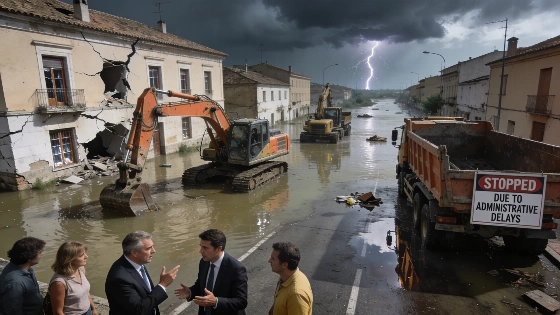
Catarroja’s mayor warns that slow bureaucracy could delay full recovery from the 2024 floods for over a decade. Despite major government funding, only 1% of projects have started. Key public works remain stalled.
In Catarroja, one of the Valencian towns most devastated by the October 2024 floods, the path to recovery is being blocked not by a lack of funds, but by administrative inertia. Mayor Lorena Silvent has publicly warned that, at the current pace, it could take 14 years for the municipality to fully restore and upgrade its damaged infrastructure. The disaster, which claimed 231 lives, left the town’s essential services in urgent need of repair, yet only a fraction of the planned projects have moved forward.
Silvent, representing the Socialist party, has repeatedly highlighted the gap between the government’s financial commitment and the sluggishness of the administrative process. In a recent press conference, she detailed how Catarroja has received significant allocations—138 million euros from the Ministry of Territorial Policy and 70 million from the Ministry for Ecological Transition—but only 1% of the recovery projects have been executed so far. Out of 38 project proposals, just 23 have been approved, and most remain stalled due to what she describes as a “paralysis of bureaucracy and staffing.”
The mayor argues that the current system is ill-equipped to handle the scale of the crisis. She is calling for a special, streamlined plan for the ten municipalities most affected by the floods, including Catarroja, Paiporta, Alfafar, Massanassa, Benetússer, Sedaví, Chiva, Utiel, Algemesí, and Letur. According to Silvent, these towns need extraordinary mechanisms to speed up project execution, as their budgets have been stretched to ten times their usual size. She acknowledges the central government’s leadership in funding the recovery but urges greater efficiency, while also criticizing the Generalitat for deflecting responsibility onto Madrid.
One of the most pressing issues is the reconstruction of the Berenguer Dalmau public institute, which was destroyed in the floods. While the regional government has prioritized other facilities, the new school is not expected to open until the 2028-2029 academic year. Meanwhile, the Ministry of Finance has resisted calls for emergency procedures, citing European Union rules that penalize non-standard processes due to the risk of irregularities. Silvent also points to the reluctance of key municipal officials to sign off on certain documents and the slow pace of the public company Tragsa, which is responsible for much of the project management.
Recruiting qualified architects and engineers has proven difficult, as many prefer the private sector or seek stable, long-term positions rather than temporary contracts. This shortage further complicates efforts to move projects forward. Despite these obstacles, the mayor has outlined several priority initiatives totaling over 25.4 million euros. The Teatre Auditori de Catarroja (TAC) remains closed but is set to receive 9.09 million euros for upgrades, pending final contract awards. The municipal sports complex’s indoor pool, one of the least damaged facilities, is awaiting approval for a 7.5 million euro overhaul. The Escola de Persones Adultes (EPA), housed in a protected building, will be rebuilt in two phases with a 1.75 million euro budget, aiming to provide improved educational spaces and a modern library.
Plans for the Plaza Mayor include a 7.87 million euro investment to adapt the square to climate change, upgrade drainage, and replace unsuitable paving. Emergency repairs to the sewer system, already costing nearly one million euros, will be followed by a 5.7 million euro improvement project funded by the Ministry for Ecological Transition, set to begin next week. The mayor hopes that all major projects will be underway or awarded by late 2026, but warns that without a change in administrative procedures, delays will persist.
This struggle to translate funding into action echoes broader challenges faced by Spanish municipalities in the wake of natural disasters. The situation in Catarroja highlights the tension between urgent local needs and the constraints of national and European regulations. Similar issues of bureaucratic delay and cross-government disputes have surfaced elsewhere in Spain, as seen when regional and central authorities clashed over the removal of longstanding barriers, such as during the dismantling of the Gibraltar border fence—a process that also required years of negotiation and adaptation to new administrative realities. For more on how such obstacles have shaped local recovery efforts, see this report on the historic removal of the Gibraltar border fence.
Spain’s experience with post-disaster recovery underscores the importance of not only financial resources but also agile governance. As climate-related events become more frequent, the ability of local administrations to respond quickly and effectively will remain a critical issue. The case of Catarroja serves as a stark reminder that rebuilding after catastrophe is as much about cutting through red tape as it is about bricks and mortar.