Moroccan political parties revive sovereignty demands over Ceuta and Melilla. Migrants stranded in Ceuta face harsh conditions. Humanitarian concerns are sidelined as the election campaign intensifies.
Hundreds of Moroccan families are still searching for relatives who disappeared trying to swim to Ceuta. The city, one of Spain’s autonomous enclaves, remains at the center of a political dispute. More than 2,000 identified Moroccan minors are still in Ceuta, caught between Spanish and European child protection laws and calls for their return. Meanwhile, the worsening situation for migrants stuck in the enclave has faded from Morocco’s political agenda as the election campaign intensifies.
Nationalist talk about Ceuta and Melilla has grown louder in Moroccan politics, but the focus on sovereignty has pushed the struggles of irregular migrants to the background. Both government and opposition parties have used the issue of the two Spanish cities—long claimed by Morocco—as a rallying point. The Partido Autenticidad y Modernidad, Partido Istiqlal, and the opposition Partido del Progreso y del Socialismo have all publicly backed Morocco’s claim. At a recent football match, fans of Magreb Asociación Deportiva from Fez unfurled a huge banner in Spanish: “Ceuta y Melilla, dos ciudades, una sola patria: Marruecos.”
The unprecedented mass border crossing at the end of July 2026 saw approximately 80,000 people enter Ceuta in just two days, according to a European Parliament briefing.
As legislative elections approach, official statements have become more guarded. The Moroccan Ministry of Foreign Affairs, in a recent communiqué, avoided direct mention of Ceuta and Melilla, signaling a move away from open confrontation. What was once a central theme now seems to have been set aside as political leaders try to avoid further escalation.
While politicians trade slogans, Moroccan civil society groups warn of rising hostility and xenophobia toward migrants in Spain. The Liga Marroquí para la Defensa de los Derechos Humanos, linked to the Partido Istiqlal, has accused Spanish authorities of ignoring attacks on Moroccan migrants in Ceuta and tolerating extremist groups. A small protest outside the Spanish Embassy in Rabat was the first such demonstration since the crisis began, showing how little public mobilization there has been on the issue.
The humanitarian cost is clear. The Consejo Nacional de Derechos Humanos has accused Spanish security forces of mistreating migrants who arrived en masse in Ceuta at the end of July and of failing to provide adequate care. The same group previously blamed Spanish police for at least 23 deaths during the 2022 Melilla border incident involving sub-Saharan migrants.
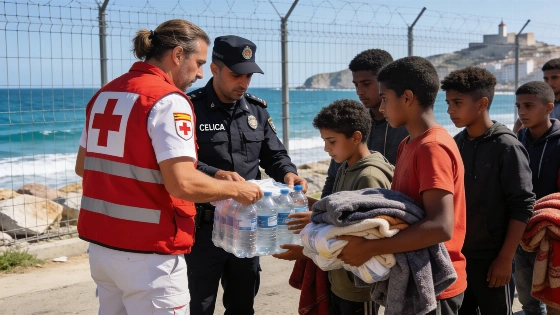
Spanish authorities have reported that, since August 10, more than 5,300 people have been returned to Morocco to ease the pressure on Ceuta, with an additional 1,000 in the process of repatriation. Local officials warn that the city’s main reception center, designed for just 29 minors, has been overwhelmed by hundreds and even thousands of unaccompanied children, according to European Parliament and regional sources.
Conditions for those stranded in Ceuta are grim. Reports describe makeshift camps filled with garbage, and migrants suffering from untreated wounds and insect bites. Many describe the city as a “giant prison” or an “open-air waiting room” for Europe. A 36-year-old migrant from Fez, now living on Ceuta’s Trampolín beach, warns others not to attempt the crossing, citing hunger, violence, and abuse.
Despite promises from Moroccan politicians—such as raising the minimum wage to 5,000 dirhams—most migrants have little hope for change at home. Activists like Jadiya Inani from the Asociación Marroquí de Derechos Humanos point out that returning to Morocco often means facing police interrogations and legal trouble, especially for those who have spoken publicly about violence. The reasons driving irregular migration remain unresolved.
As reported earlier, the debate over Ceuta and Melilla keeps resurfacing in European institutions, but practical solutions for those caught in the middle are still missing. Spanish authorities have received at least 200 reports from families searching for missing youths, while many bodies remain unidentified and unclaimed because Morocco refuses to accept their return without the repatriation of minors.
The current political climate in Morocco shows how nationalist agendas can overshadow urgent humanitarian needs. While sovereignty claims over Ceuta and Melilla dominate headlines and campaign speeches, the real crisis is unfolding among those left in limbo—migrants facing neglect, families desperate for answers, and children whose futures are suspended between two legal systems. The silence from political leaders on these consequences is a reminder that, during election season, the most vulnerable are often the first to be forgotten.