Nearly 200 migrants left Ceuta for Morocco after police cleared the Benítez beach camp. Officials called the returns voluntary, but lawyers say those who refused faced identification and a possible expulsion process.
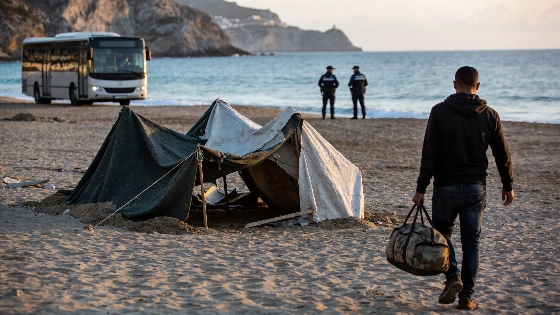
Before dawn on Tuesday, riot police entered the last stretch of Benítez beach near El Trampolín. Around 400 people of Maghrebi origin had been living there after crossing into Ceuta during the mass entry between 30 and 31 July. Most were adult men. Teenagers were also among them.
Police had already removed much of the settlement on Sunday. The second operation dismantled the remaining shelters. Nearly 200 migrants later returned to Morocco after being taken from the beach by bus to the border.
The authorities described those departures as voluntary. But the other option was entry into the CATE and the start of an official process that could lead to expulsion or an asylum application.
Reuters reported that more than 72,000 migrants reached Ceuta during the mass arrival at the end of July. After most subsequently left the enclave, Spain’s territorial policy minister Ángel Víctor Torres estimated that about 3,500 people remained outside accommodation centres.
Inside the makeshift cabins, migrants woke to officers ordering everyone outside. They carried bags with their few belongings and repeatedly asked whether they were being taken to Morocco.
About 30 people broke through the police cordon and ran away. Officers brought only around six of them back. An Arabic interpreter then explained that buses would take the others to the CATE at the El Tarajal crossing.
The border mattered most.
At the CATE, the migrants were given two options. They could enter the centre for identification and later move to accommodation in Loma Colmenar. Or they could cross back into Morocco immediately under the formula of “voluntary return”.
The distinction matters. Those removed from the beach had not arrived at the border on their own. Police had made them leave the sand and transported them there under supervision.
Morocco’s Foreign Minister Nasser Bourita said Rabat was ready to receive migrants from Ceuta as soon as possible, while also blaming Spain for delays in arranging the returns.
Police sources acknowledged the contradiction. The return is officially voluntary, but it can look close to compulsory when the alternative is registration inside the CATE.
Once migrants are identified, their files can move towards a return or expulsion procedure. They may also request international protection.
Lawyer Carmen García said Moroccan applicants are highly likely to have asylum refused because Morocco is treated as a safe country. A negative decision could make a later removal from Ceuta easier if the person tries to enter again.
Leaving without registration avoids that immediate screening. It also preserves another possible route to request asylum in the future.
That legal calculation helps explain why people who had spent two months sleeping outdoors eventually crossed the border. Many had openly rejected a return.
The word “voluntary” describes the final step. It does not describe the pressure created by the clearance and the two choices that followed.
On the Moroccan side, police held the migrants in the Fnideq area and placed them on other buses. A Moroccan officer told EL PAÍS that they would be taken to different points in Morocco and to their cities of origin.
It was not clear where each group would end up. It was also unclear whether some would try to enter Ceuta again.
The remaining migrants were taken into the CATE. Minors were transported in a van to a reception centre.
In Madrid, minister Ángel Víctor Torres said a significant number of returns were taking place as return files were opened. Government figures cited 8,243 returns since 10 August, including 1,134 during the latest week.
Of those returns, 7,794 were classified as voluntary and 449 as expulsions. Reuters later reported that Torres estimated up to 3,500 people could still be outside accommodation centres in the enclave.
An earlier report described a public authority response in a housing dispute through an earlier agreement. In Benítez, the pressure came from eviction, transport to the border and the immediate choice between registration and departure.
Police are expected to clear the El Trampolín area in the coming days. That could increase the number of returns classified as voluntary.
The Spanish government is also considering stricter asylum rules for Ceuta, according to Reuters. A draft approach could require some rejected applicants from countries deemed safe by the European Union, including Morocco, to pursue appeals from outside Spain.
The proposal has not been confirmed. It could still narrow the practical route available to people seeking protection.
For the migrants involved, the real choice is narrower than the official wording suggests. The next operations will test how long that distinction can hold.