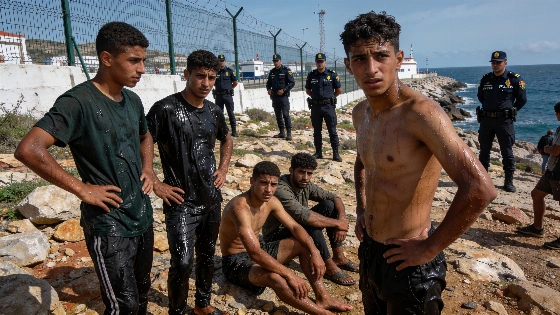
Ceuta is under intense strain after thousands crossed from Morocco, many by swimming. The city’s president has called for a national emergency and border closure. Madrid has sent the Interior Minister to assess the escalating situation.
Ceuta is experiencing one of its most severe border crises in recent years, as thousands of mostly young migrants from Morocco have entered the Spanish enclave, many by swimming and others by scaling the border fence. The surge, which has unfolded over the past ten days, has pushed local services to their limits and prompted urgent political action.
On Thursday, Juan Jesús Vivas, president of Ceuta, formally requested the Spanish government to declare a national emergency and close the border with Morocco. This appeal, supported by all local political parties, comes after nearly 2,000 people arrived by sea and a coordinated mass crossing saw thousands more breach the border fence separating Castillejos and Ceuta. The influx included entire families, women, and children, overwhelming the city’s reception facilities.
Prime Minister Pedro Sánchez responded by personally calling Vivas to assure him that the government is preparing an extraordinary response. As an immediate step, Interior Minister Fernando Grande-Marlaska is scheduled to visit Ceuta on Friday to monitor the situation and coordinate further actions. However, the government has ruled out activating the national emergency mechanism, citing that current civil protection laws do not classify migration flows as grounds for such a declaration.
Vivas, however, maintains that the situation meets the criteria for a declaration of interest for National Security under Article 23 of the National Security Law, rather than a civil protection emergency. He has pressed this point in discussions with Sánchez, emphasizing the gravity of the crisis and the urgent need for decisive measures, including increased security forces and a temporary border closure.
The pressure on Ceuta’s border has been building for days, with arrivals by sea giving way to a dramatic escalation on Thursday morning as thousands converged on the perimeter fence. Local authorities report that the action appeared coordinated, with large groups moving together toward the crossing. Reception centers have been stretched beyond capacity, and the city’s leadership has warned that the situation is unsustainable without immediate national intervention.
Similar episodes have tested Ceuta’s resources in the past, as highlighted in reports such as coverage of previous surges in migrant arrivals and emergency responses. However, the current wave stands out for its scale and the speed at which pressure has mounted on local infrastructure and services.
Ceuta, a Spanish autonomous city on the North African coast, has long been a focal point for migration from Morocco and sub-Saharan Africa. Its unique geographic position makes it both a gateway to Europe and a flashpoint for border tensions. Spanish law distinguishes between civil emergencies and national security incidents, which affects the type of government response available. While the government has so far declined to declare a national emergency, the deployment of senior officials and the ongoing review of security measures underscore the seriousness of the situation. The outcome of these discussions may set important precedents for how Spain manages future migration pressures at its external borders.