Five days after over 40,000 migrants swam into Ceuta, the city remains divided. Central areas appear calm under heavy police control, but the outskirts struggle with overcrowding and uncertainty.
Ceuta remains on edge five days after more than 40,000 migrants entered the city by swimming across the border. While the city center now shows signs of order, maintained by a strong police and military presence, the situation in outlying neighborhoods is far from resolved. Authorities estimate that around 2,500 people who crossed irregularly are still in Ceuta, with many unable to find shelter or basic necessities.
In the heart of the city, tourists have cautiously returned to the streets, which until recently were filled with hundreds of migrants. The military continues to enforce an unofficial exclusion zone, keeping migrants away from central areas. On Monday, the Tarajal beach—scene of last week's mass entry—welcomed its first bathers since the crisis began. The border itself now appears quiet, guarded by only a few vehicles and a handful of Guardia Civil officers, a stark contrast to the heavy deployments seen earlier.
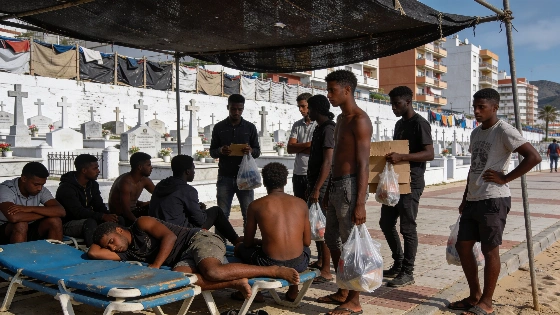
However, just a few kilometers away, the reality is different. Near the Benítez neighborhood, at Playa del Trampolín, dozens of migrants gather under umbrellas, in the shade of the promenade, or on abandoned sunbeds. The flow has slowed, but it has not stopped. Many have nowhere to go, as the Centro de Estancia Temporal de Migrantes (CETI), located just 300 meters away, is operating far beyond its capacity. Groups of sub-Saharan, Bangladeshi, and Syrian migrants wait outside the center, hoping for a place that is unlikely to become available. The director of the CETI struggles to drive through the crowd at the entrance, while local residents have put up barriers to prevent access to their housing complexes.
The tension in these areas is palpable. Men of all ages wander the streets, carrying cardboard and plastic bags, searching for somewhere to spend the night. Bakeries in the neighborhoods remain without bread, issuing tickets to be exchanged when supplies return. The white walls of the old Muslim cemetery of Sidi Embarek are marked with dark stains, evidence of repeated attempts to climb over them. Inside, migrants—mostly Moroccan—have found makeshift shelter, using maintenance hoses to wash and arranging beds between the tombstones.
Residents report a constant presence of journalists from around the world, reflecting the global attention on Ceuta. Along the seafront, the scene alternates between soldiers and television crews, each searching for migrants—some to redirect them to the CETI, others to interview them on camera. Migrants sleep outdoors and repeat the same routine each day, highlighting the ongoing uncertainty.
This tense atmosphere follows a period of violence and chaos that forced thousands of migrants to leave Ceuta and return to Morocco, as detailed in reports of recent unrest and border closures. The authorities continue to face challenges in restoring stability, with food shortages and strained resources affecting both migrants and local residents.
Ceuta's unique position as a Spanish enclave on the African continent has long made it a focal point for migration. The recent events have exposed the city's limited capacity to manage sudden influxes, especially when support systems are overwhelmed. The CETI, designed for temporary stays, is unable to accommodate the current numbers, leaving many migrants in limbo. Local infrastructure, from bakeries to public spaces, is under pressure, and the visible division between the calm center and the crowded outskirts underscores the complexity of the situation. As the city seeks a path back to normality, the balance between security, humanitarian needs, and daily life remains fragile.