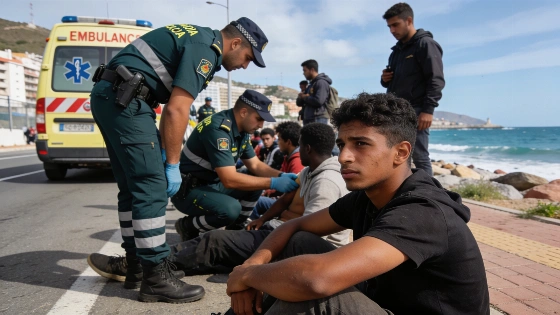
Ceuta’s border was overwhelmed as thousands entered from Morocco. Emergency services focused on the injured. The city’s president called for a national emergency and central government control.
Ceuta experienced its most intense influx of migrants in recent days, as thousands crossed from Morocco into the Spanish enclave around midday on Thursday. The sudden surge followed a relatively calm night, but by noon, the situation had escalated sharply. Most arrivals were young people who either swam around the border breakwater or moved quickly along the coastal road, bypassing controls and overwhelming local authorities.
With the volume of people entering, the Guardia Civil and emergency teams were unable to manage the flow and instead concentrated their efforts on assisting those who were injured during the crossing. The city’s resources, already stretched thin by a week of heightened arrivals, reached a breaking point. The Centro de Estancia Temporal de Inmigrantes (CETI) has been operating at full capacity for days, leaving no available places for new arrivals and raising concerns about hygiene and public health.
Ceuta’s president, Juan Jesús Vivas, responded by formally requesting the Spanish government to declare a national emergency and assume direct control of the situation. This move reflects the scale of the crisis, which many in the city compare to the events of 2021, when a single day saw around 5,000 people cross the border. The current wave has reignited debate over Spain’s border management and the capacity of local services to respond to sudden mass arrivals.
According to recent coverage of similar events, Ceuta has faced repeated challenges in managing large-scale entries, with local officials consistently calling for greater support from Madrid. The ongoing pressure has highlighted the need for coordinated action between local and national authorities, especially as the CETI remains overburdened and emergency services struggle to keep pace.
Ceuta’s unique position as a Spanish territory bordering Morocco makes it a frequent entry point for migrants seeking to reach Europe. The city’s infrastructure is not designed for sustained mass arrivals, and each new wave tests the limits of its emergency response. The Spanish government’s next steps will be closely watched, as the situation in Ceuta often signals broader trends in migration and border policy across southern Europe.