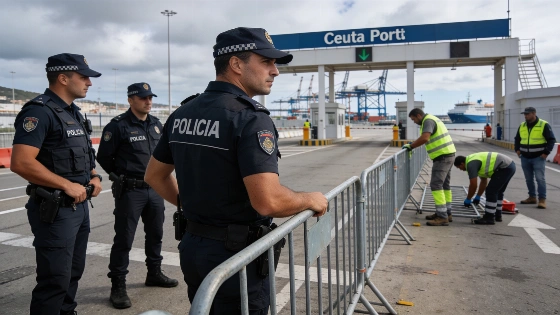
Ceuta’s president initially backed using the port for migrants but later withdrew support. The reversal triggered Madrid’s intervention and accusations of sabotage. Official records reveal the full sequence of events.
Ceuta’s political crisis deepened after the city’s port board, led by allies of president Juan Jesús Vivas, voted to block the use of port facilities for housing migrants. This came just days after Vivas had formally agreed to the plan in meetings with Madrid. The sudden change angered the Spanish government. Minister of Transport Óscar Puente called the move sabotage, and Madrid responded by taking control of the port to move forward with the migrant relocation.
Records from two meetings attended by Vivas, Prime Minister Pedro Sánchez, and key ministers show Vivas gave clear support for using the port. Minutes reviewed by EL PAÍS confirm that after other sites—such as sports halls, a flour factory, and a military hospital—were ruled out, Vivas agreed the port was the only workable option. The government then removed the other locations from the emergency decree, meeting Vivas’s conditions in exchange for his approval.
The Spanish government authorized the temporary use of 16,000 m² of the Ceuta port for migrant accommodation, invoking Article 73.3 of the Ports and Merchant Marine Law.
At the first meeting, Sánchez called for calm and solidarity in Ceuta, emphasizing the need to move migrants off the streets. Vivas agreed, asking for a clear plan to ease pressure on the city. The minutes show a unanimous vote—including Vivas’s—for the port’s inclusion as a site for migrant accommodation. The next day, at the National Security Council, Vivas again supported the plan, and no one objected before the Council of Ministers finalized the decision.
But by Friday, the port’s board—under Vivas’s influence—voted 11 to 4 against using the facilities. The Partido Popular now argues the port is critical infrastructure and not suitable for migrants, reversing their earlier position. The government sees this as a deliberate attempt to delay the relocation, forcing Madrid to override local control and set up temporary shelters for 1,000 migrants.
According to the Ministry of Transport, the official motivation for Madrid’s intervention was the exceptional nature of the situation and the urgent humanitarian need to provide shelter for over 1,000 migrants. The government’s resolution specified that the designated port area would be used for tents and emergency assistance, and that port operations would continue, albeit with possible limitations. This direct intervention by central authorities, bypassing local opposition, sets a precedent for future management of Spain’s port infrastructure in crisis scenarios.
This standoff is the latest in a series of clashes that have already seen Madrid override Ceuta’s authorities, as detailed in a previous report. The episode highlights how fragile cooperation between local and national governments can be in Spain’s migration policy, especially when political interests shift quickly.
Ceuta’s port, a key asset for the enclave, has become the center of a wider debate over how Spain handles sudden arrivals of migrants at its borders. The government’s decision to take direct control shows it is willing to bypass local resistance when national priorities are involved. For residents, the dispute means ongoing uncertainty about where migrants will be housed and whether local leaders’ public statements match their actions. The episode also shows the risks of political maneuvering in a crisis, where last-minute reversals can erode trust and force central authorities to step in. In the end, the Ceuta case shows how quickly official agreements can fall apart when local and national agendas collide.