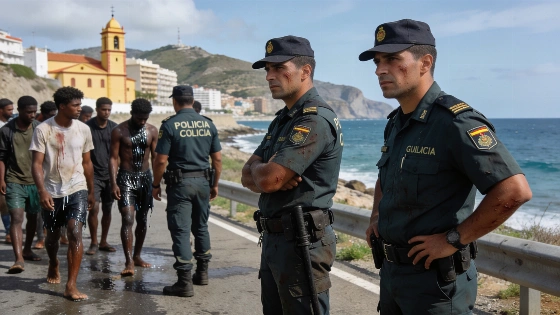
Ceuta faces a critical situation as hundreds of migrants arrive by swimming. Police and Guardia Civil report exhaustion and demand urgent legal and resource changes. The Interior Ministry promises reinforcements.
Ceuta’s police and Guardia Civil are warning of an unprecedented operational crisis as hundreds of migrants continue to reach the city by swimming from Morocco. The situation, described by local officers as worse than the 2021 migration crisis, has left security forces stretched to their limits and prompted urgent calls for legal and logistical changes.
According to officers on the ground, the recent Supreme Court decision banning immediate border rejections for those arriving by sea has sharply increased pressure on local resources. The Ministry of the Interior has announced additional personnel and equipment, but agents insist that the scale of arrivals now exceeds what can be managed by simply adding more staff. Rachid Sbihi, provincial secretary of the Asociación Unificada de la Guardia Civil (AUGC), described scenes of roads filled with migrants and noted that a group of 300 recently broke through police lines after being rescued from the water. He stressed the need for clear, written operational instructions from Madrid, highlighting the critical nature of the situation and the recovery of over 25 drowned migrants in recent days.
While Guardia Civil officers form the first line of response at sea and along the breakwater, National Police are responsible for registering, identifying, and processing each arrival for potential expulsion. Aaron Álamo, secretary of the Sindicato Unificado de Policía (SUP) in Ceuta, reported that the Foreigners’ Brigades are overwhelmed. He compared the current crisis to the 2021 incident, noting that expulsions are now far more difficult due to the Supreme Court ruling. Álamo called for the immediate opening of a Centro de Atención Temporal de Extranjeros (CATE) to provide initial care and identification, and argued that only a change in immigration law would allow authorities to reject swimmers at the border again.
The SUP has warned that the lack of staff, resources, and legal tools will make it nearly impossible to expel many of the new arrivals. Each interception now requires more identification, custody, legal assistance, interpreters, and administrative work, all with insufficient personnel. The union fears this will reinforce the perception that crossing the border irregularly carries few consequences and that deportation is unlikely once inside Spanish territory.
Other police associations, including Justicia Policial (Jupol) and Justicia para la Guardia Civil (Jucil), have echoed calls for urgent legal reform and new bilateral readmission agreements with countries of origin and transit, especially Morocco. Jupol’s spokesperson, Ibón Domínguez, described the situation as a collapse and warned of broader impacts on public safety. Jucil’s Agustín Domínguez said the city is now a “powder keg,” with officers exhausted and unable to control or identify all arrivals. He called for an immediate reinforcement of 400 additional Guardia Civil agents, nearly doubling the current deployment.
The Interior Ministry has responded by sending a sub-group from the Grupos de Reserva y Seguridad (GRS) and an additional patrol boat to support the eight already operating in the area. Officials insist that all relevant ministries are coordinating their response and that Morocco is cooperating closely, with Moroccan security forces reportedly preventing many attempted crossings.
Operational strain on Spain’s security forces is not limited to Ceuta. Nationwide, the Guardia Civil has recently raised concerns about the feasibility of responding to every emergency, as seen in the context of the DGT’s V16 beacon plan, where traffic patrols are already stretched thin. For more on the challenges facing Spain’s security services, see this report on the difficulties of nationwide emergency response coverage.
Ceuta’s unique position as a Spanish enclave bordering Morocco has long made it a focal point for migration into Europe. The current crisis highlights the complex interplay between legal rulings, operational capacity, and international cooperation. The Supreme Court’s decision has effectively closed off the option of immediate returns for those arriving by sea, forcing authorities to process each case individually. This not only increases the administrative burden but also raises questions about the sustainability of current migration management strategies. The government’s response in the coming weeks will be closely watched, as both local officers and national unions warn that without swift legal and logistical changes, the situation could deteriorate further.