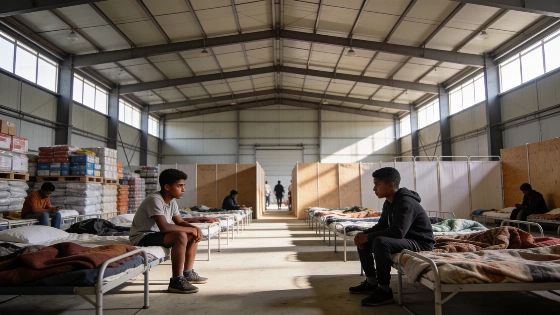
Ceuta authorities are urgently converting industrial spaces to shelter 862 migrant minors after a mass arrival. The city expects numbers to rise further and is requesting more support from Madrid. Existing facilities are severely overcrowded.
Ceuta’s government is racing to adapt two large industrial buildings to accommodate 862 migrant minors, following a sudden influx that has overwhelmed the city’s existing resources. Officials warn that the number of unaccompanied minors could soon approach 1,000, far exceeding the city’s standard capacity of just 29 places. The local administration is now seeking additional financial support from the central government to manage the escalating emergency.
Currently, minors are being housed in all available city facilities, but conditions are cramped. According to Alberto Gaitán, Ceuta’s Councillor for the Presidency and head of the Minors area, the new spaces should be ready within hours or days. Until then, many children remain in temporary or makeshift accommodation, with some having initially slept outside the newly prepared warehouse near the El Tarajal border. Authorities admit that some minors are still unaccounted for on the streets, and efforts are underway to locate and bring them into care.
Transfers of minors to mainland Spain have not taken place in recent days due to administrative requirements, but the city plans to request further relocations under the Real Decreto Ley/2025, which amended the relevant organic law. Over the past year, Ceuta has already transferred 655 minors to the peninsula, but the pace of arrivals has outstripped these efforts. Gaitán notes that the number of minors in care has surged from 200 in July to the current 862, with the city’s services stretched to the limit providing food, clothing, and shelter.
The youngest children, whose age is not in doubt, have been prioritized for better accommodation, while older minors are being placed in provisional settings. It is common for some children to stay temporarily with relatives or acquaintances before seeking help from city services, making it difficult to determine the exact number in need. The city continues to comb neighborhoods to identify and assist those still outside the system.
One of the main facilities being adapted is a large industrial warehouse in the El Tarajal industrial zone, a site previously used during earlier waves of arrivals. Ceuta’s government has repeatedly stressed that it cannot handle such numbers alone and has called for urgent intervention from Madrid. The scale of the current crisis is underscored by the fact that the city is operating at nearly 3,000% over its official capacity.
This latest surge follows a period of mounting pressure on Ceuta’s infrastructure, with the city already struggling to cope with previous waves of arrivals. The humanitarian and logistical challenges have been compounded by the need to ensure safe, dignified conditions for minors, many of whom arrive after dangerous journeys. The situation has also led to broader strains on local services, as highlighted in recent reports about the impact on Ceuta’s temporary morgue and the difficulties in managing the aftermath of mass crossings at the border. For further context on the ongoing crisis and its effects on local facilities, see the detailed coverage of the strain on Ceuta’s provisional morgue in this recent report.
Ceuta’s experience reflects a wider challenge faced by Spanish border regions, where sudden increases in arrivals can quickly overwhelm established systems. The city’s call for additional resources and legislative flexibility highlights the need for coordinated responses at both regional and national levels. As the situation develops, the focus remains on providing immediate care for vulnerable minors while seeking longer-term solutions to prevent further humanitarian strain.