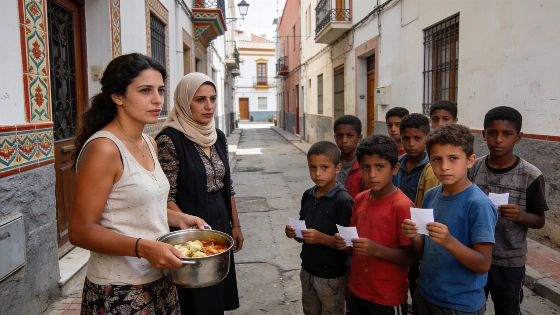
Ceuta’s El Príncipe neighborhood faces a wave of migrant minors after a mass border crossing. Locals step in as authorities struggle to provide shelter and support. Improvised censuses and community aid highlight the scale of the crisis.
Ceuta’s El Príncipe Alfonso district is at the center of a humanitarian emergency after hundreds of unaccompanied migrant minors arrived following a mass border crossing. With official resources stretched thin, local residents have taken the lead in registering and caring for children left without shelter or guidance.
In recent days, the labyrinthine streets of El Príncipe have seen a constant flow of minors, many of whom entered Spain by swimming across the border. The authorities, unable to accommodate the sudden influx, have left much of the responsibility to the community. Residents have responded by distributing food, clothing, and makeshift registration forms, attempting to keep track of the children scattered throughout the neighborhood.
According to local leaders, the situation has surpassed anything previously experienced. Abdellah Mustafa, president of the Sidi Embarek neighborhood, described how police dispersed migrants into El Príncipe, overwhelming the area. The influx has led to chaotic scenes, with children and teenagers seeking shelter in cemeteries, beaches, and abandoned buildings. Many have no contact with their families and little information about what will happen next.
Efforts to manage the crisis have included an unofficial census, coordinated by Ahmed Enfed-dal, president of the El Príncipe neighborhood association. Volunteers have collected over a thousand handwritten notes with names and contact details, storing them in boxes at a local church annex. While the Red Cross has promised assistance, for now, residents are left to manage the situation alone.
With official shelters full or located far from the neighborhood, many families have opened their homes to minors, providing meals and a place to sleep. However, resources are running low. One resident, Raiba, explained that she has exhausted her food reserves caring for two boys alongside her own children. The atmosphere is one of solidarity, but also exhaustion and frustration, as uncertainty persists about when or if authorities will intervene more decisively.
Some residents recall the 2021 migration crisis, when a similar wave of minors arrived in Ceuta. Then, as now, locals provided initial support before the children were eventually transferred to centers on the mainland. This time, however, the scale and speed of arrivals have left many feeling abandoned by officials. Uzman Bersabé, spokesperson for the Al Ambar association, noted that plans to relocate minors to sports facilities remain unconfirmed, deepening the sense of instability.
Amid the daily challenges, tensions occasionally flare. Rumors of police presence can cause panic, though officers rarely enter the neighborhood. The arrival of new minors continues, with some children fleeing police elsewhere and ending up in El Príncipe, adding to the community’s burden.
Ceuta’s experience is not isolated. The city has repeatedly faced surges in migrant arrivals, prompting calls for national and European support. As highlighted in a related report, the local government has previously urged Madrid to declare a national emergency in response to similar crises (see analysis of Ceuta’s emergency appeal). The current situation in El Príncipe underscores the ongoing challenges of managing migration at Spain’s borders, especially when official systems are overwhelmed and local communities are left to fill the gaps.
Ceuta, a Spanish enclave on the North African coast, has long been a focal point for migration from Morocco and sub-Saharan Africa. The city’s unique geography and political status make it a frequent entry point for those seeking a new life in Europe. The events in El Príncipe highlight the human impact of border policy and the crucial role played by ordinary residents when institutional responses fall short.