Ceuta’s new school year begins under strict security. Local families confront the reality of migrant children living in makeshift camps. The city’s border crisis exposes sharp contrasts in childhood and opportunity.
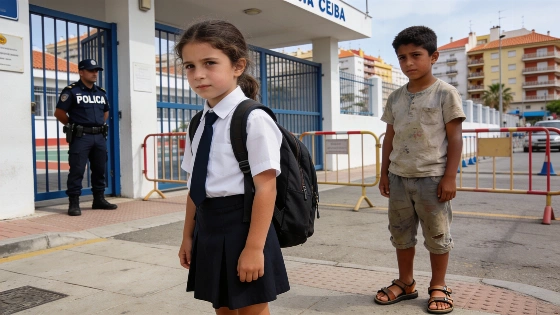
The start of the school year in Ceuta looks different now. Security barriers and police patrols line the way to classrooms, a response to the recent arrival of migrant children from Morocco. For some families, school begins as usual. For others, it is out of reach.
Ángela, 10, is eager to return to her city-center school. Her brother Hugo, 12, is less enthusiastic about starting at a new institute. Their mother, Tamara Iglesias, says she feels lucky to live in central Ceuta, away from the tension on the city’s edges. She is honest with her children: kids their age, or younger, are now on the streets outside, barefoot and unsure when they last ate.
According to Spain's Ministry of Territorial Policy, around 2,000 minors crossed into Ceuta during the July border crisis, with family reunification remaining a top priority for authorities.
Just a few blocks away, the difference is clear. Rayan and Sulaiman, close in age to Ángela and Hugo, arrived from Castillejos after their mother, Hayat, decided to cross the border. They now live in a temporary shelter at Sidi Embarek, where 250 migrants stay with help from the NGO Luna Blanca. On Fridays, local groups organize activities to give the children some routine, but their future is uncertain.
Khalid, 17, left Casablanca alone and now lives at the beach settlement known as Trampolín. The area has become a makeshift city, with informal shops and even a barber. Khalid moves through the camp as if it were his own neighborhood, but his plans—he wants to be a pilot—are clouded by uncertainty and the absence of family.
Ceuta’s authorities have increased security around schools to reassure parents and keep order. Reports from Spain's Ministry of Education say the academic year is starting with more police at schools and on school transport, along with a psychosocial support program for students, families, and teachers. Still, the divide remains: some children prepare for lessons, others live in shelters or on the streets. The city’s social fabric is stretched, and the crisis has forced families to face uncomfortable questions about privilege, belonging, and the limits of local support.
The city has registered 12,870 students for the new school year, but the opening of two municipal nurseries for children aged 0–3 was postponed until September 28 due to administrative delays, a decision that coincided with tensions over a new migrant center near one of the facilities. Local media also report that since July 30, there have been attempts to enter seven educational institutions, prompting further security measures.
This is not an isolated situation. As reported earlier, Ceuta’s border neighborhoods are under strain, with protests over new migrant centers near schools. The city is divided between those who see migrants as a threat and those who try to help, but the practical problems—crowded shelters, limited resources, and the daily presence of vulnerable minors—remain unsolved.
Spain’s migration policy is being tested in Ceuta, where the border crisis is not just about numbers but about daily life for families on both sides. The contrast between children like Ángela and Hugo, who return to structured classrooms, and those like Rayan, Sulaiman, and Khalid, who face an uncertain path, shows the limits of current responses. Until authorities address both immediate needs and long-term integration, Ceuta’s classrooms will reflect division more than opportunity. The city’s future depends on whether it can move beyond emergency measures and offer real prospects to all its children, not just those born on the right side of the border.