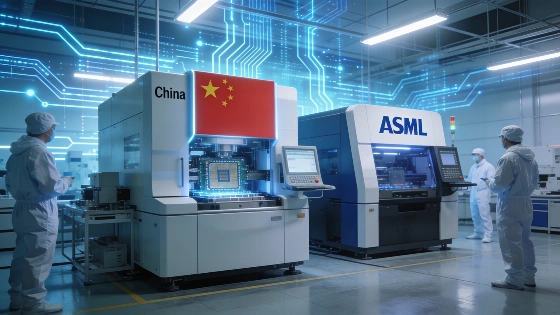
A Chinese company has started mass-producing a critical chipmaking tool. Analysts warn that performance and scale remain uncertain. ASML's dominance is not expected to be seriously threatened in the near term.
China has entered the global chipmaking equipment market with the reported mass production of immersion deep ultraviolet lithography (DUV) machines, a technology long monopolized by ASML. According to The Information, an unnamed Chinese manufacturer has begun delivering these tools to major domestic chipmakers, including Semiconductor Manufacturing International Corp and Changxin Memory Technologies. The move comes as global semiconductor stocks, including ASML, experienced a sharp sell-off, reflecting investor concerns about potential shifts in the sector.
Despite the headlines, industry analysts remain cautious about the real impact of this development. The main questions focus on whether the Chinese DUV machines can match ASML’s performance and whether production can be scaled to meet broader demand. Yield—the proportion of usable chips produced—is a critical metric for chip manufacturers. At present, there is no clear evidence that the new Chinese machines can deliver yields comparable to those achieved with ASML’s equipment. Without this parity, widespread adoption by leading foundries is unlikely.
Production capacity is another significant hurdle. The Chinese firm reportedly aims to produce just five DUV units this year, with a target of 20 by 2027. In contrast, ASML plans to manufacture around 130 DUV immersion machines in 2026, increasing output by 30% the following year. Analysts highlight that scaling up production and ensuring consistent reliability across a fleet of machines is a complex process that typically requires years of refinement—an area where ASML has a substantial head start.
For ASML, the immediate financial impact appears limited. Due to export restrictions, the Dutch company is already barred from selling certain DUV tools to Chinese clients. As a result, any domestic Chinese production mainly replaces sales that ASML cannot legally make. In the second quarter, China accounted for 14% of ASML’s net system sales, but analysts suggest that the new competition is unlikely to erode the company’s global position in the short term. To truly challenge ASML, the Chinese manufacturer would need to consistently produce reliable machines and support them across diverse manufacturing environments worldwide—a scenario that experts consider distant.
Looking ahead, some attention has turned to whether China could replicate this progress with even more advanced chipmaking tools. Last year, Reuters reported that China had developed a prototype of an extreme ultraviolet (EUV) lithography machine, a technology that remains exclusive to ASML. However, industry observers note that breakthroughs in DUV do not automatically translate to success in EUV, which required ASML and its partners decades and billions of euros to commercialize. The technical barriers for EUV remain significantly higher, and most analysts believe that China is still far from matching ASML’s capabilities in this area.
For context, DUV lithography is essential for producing less-advanced chips, while EUV is required for the most cutting-edge semiconductors used by companies like Apple and Nvidia. ASML’s dominance in both segments has made it a linchpin of the global semiconductor supply chain. The emergence of a Chinese competitor in DUV production signals a potential shift, but the scale, reliability, and economic viability of these new machines remain open questions. The situation will be closely watched by industry players, especially as technological self-sufficiency becomes a strategic priority for China and other major economies.
Globally, the semiconductor industry is experiencing rapid change, driven by geopolitical tensions, supply chain disruptions, and increasing investment in domestic manufacturing. The European Union and the United States have both launched major initiatives to boost local chip production and reduce reliance on foreign suppliers. For Spain and other EU countries, developments in chipmaking technology and market competition could influence future access to advanced semiconductors, pricing, and the pace of digital transformation across industries. As the landscape evolves, the ability of new entrants to match established players like ASML will remain a key factor shaping the sector’s future.