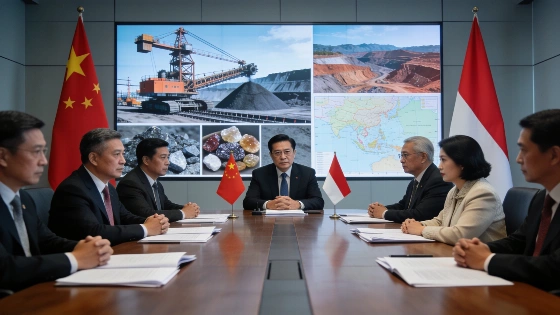
China has called on Indonesia to guarantee stable and transparent rules for its mineral sector. The demand comes as both countries expand economic cooperation. The issue was raised during high-level talks in Shanghai.
China has formally requested that Indonesia establish a more predictable and transparent regulatory environment for its mineral industry, highlighting the issue during a recent meeting in Shanghai. The call was made by Commerce Minister Wang Wentao, who met with Indonesian Coordinating Minister for Economic Affairs Airlangga Hartarto, according to a statement from the Chinese Commerce Ministry released on Saturday.
During the talks, Wang Wentao emphasized the importance of clear and stable policies in Indonesia’s mineral sector, a key area for Chinese investment and industrial supply chains. He also pointed to the need for progress on joint initiatives, including the “Two Countries, Twin Parks” project, which aims to deepen industrial and supply-chain cooperation between the two nations.
The request for regulatory clarity comes as China and Indonesia continue to strengthen their economic partnership. Both countries have seen a surge in bilateral projects, particularly in sectors tied to resource extraction and processing. The mineral industry remains a strategic focus, with Indonesia being a major supplier of nickel and other critical minerals essential for China’s manufacturing and technology sectors.
For Spain and other EU economies, the evolving relationship between China and Indonesia may have indirect effects on global supply chains, especially in industries reliant on imported minerals. Any changes in Indonesian policy or shifts in Chinese investment could influence market dynamics, pricing, and the availability of key raw materials in Europe. As the EU continues to seek diversification of its own supply sources, developments in Asia’s mineral sector are closely watched by European manufacturers and policymakers.
Indonesia has previously introduced export restrictions and regulatory changes in its mining sector, aiming to boost domestic processing and value addition. These measures have sometimes created uncertainty for foreign investors, including Chinese companies. The latest discussions signal Beijing’s intent to secure more stable conditions for its interests in the region. The “Two Countries, Twin Parks” initiative, referenced by Wang, is designed to foster closer industrial integration and could serve as a model for future cross-border cooperation in Southeast Asia.
According to public data, China is Indonesia’s largest trading partner and a leading investor in its mining and infrastructure sectors. The outcome of ongoing policy negotiations may shape the future of mineral flows not only between the two countries but also to global markets, including Spain. As international competition for critical minerals intensifies, regulatory stability in supplier countries like Indonesia becomes increasingly significant for downstream industries worldwide.