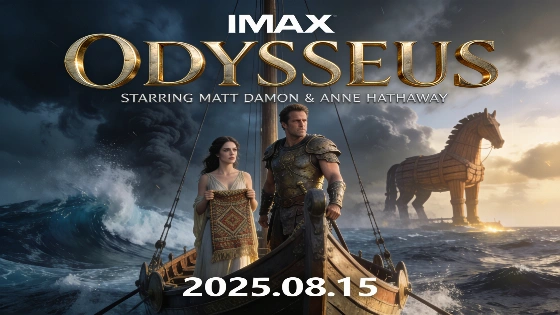
Christopher Nolan's new film adapts "The Odyssey" with a modern approach. Matt Damon stars as Odysseus, Anne Hathaway as Penelope. The movie stands out for its IMAX visuals and a blend of blockbuster and art-house elements.
Christopher Nolan’s adaptation of "The Odyssey" has arrived in cinemas, marking a significant event for both film and literature enthusiasts. The director, known for his large-scale projects, brings the ancient Greek epic to the screen with a cast led by Matt Damon as Odysseus and Anne Hathaway as Penelope. This production is notable for being the first feature shot entirely in IMAX, setting a new technical benchmark for the industry.
The film reimagines Homer’s classic poem, focusing on Odysseus’s long and perilous journey home after the Trojan War. Nolan’s version emphasizes not only the hero’s mythical adventures but also the impact of his absence on his family. Penelope and their son Telemachus, played by Tom Holland, are given more narrative space than in many previous adaptations, highlighting the emotional cost of war and separation.
While the original poem is known for its nonlinear structure and dense action, Nolan retains much of this complexity. He compresses and omits certain episodes but preserves the sweeping, fragmented storytelling. The film moves between Odysseus’s wanderings, flashbacks to the Trojan War, and the tense situation at his palace in Ithaca, where Penelope fends off persistent suitors. Robert Pattinson and Corey Hawkins appear as Antinous and Polybus, adding further star power to the ensemble.
Nolan’s approach blends blockbuster spectacle with artful storytelling. The film features elaborate set pieces, including the construction of the Trojan Horse and encounters with mythological figures such as Cyclops (Bill Irwin), Calypso (Charlize Theron), and Athena (Zendaya). Despite the scale, the director grounds the story in human emotion, portraying Odysseus as a complex, fallible man rather than a distant legend. The narrative frequently returns to the theme of identity, echoing motifs from Nolan’s earlier works.
Performances across the cast are strong, though Damon’s subdued portrayal of Odysseus stands out for its restraint. Hathaway’s Penelope remains enigmatic, often filmed behind screens or looms, while Holland’s Telemachus is given a more active role in the search for his father. Supporting characters, including Samantha Morton’s Circe and Jon Bernthal’s Menelaus, bring modern touches to the ancient tale, though some roles are necessarily brief due to the film’s scope.
"The Odyssey" is rated R for violence and language, with a runtime of 2 hours and 52 minutes. The film’s visual style is marked by striking imagery and a deliberate use of beauty to draw viewers into its intricate narrative. Nolan’s adaptation stands out for bridging the gap between mainstream entertainment and art-house cinema, reaffirming his reputation for ambitious, technically innovative filmmaking.
For context, "The Odyssey" is one of the foundational texts of Western literature, credited to Homer and composed of over 12,000 lines. Its influence extends across centuries, shaping countless stories in literature and film. Nolan’s decision to adapt this work reflects both the enduring relevance of the original and the director’s ongoing interest in stories about identity, memory, and the consequences of human action. The film’s release is likely to spark renewed interest in classical themes within contemporary cinema.