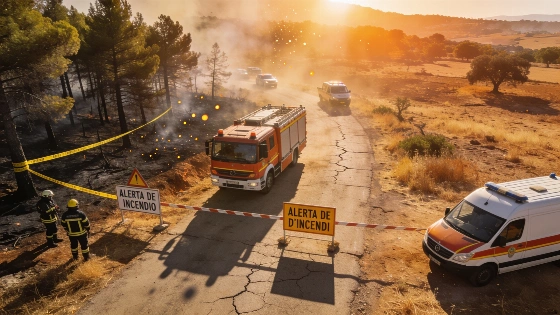
Civil Protection has extended heat and wildfire alerts in Catalunya. Emergency services remain on high alert. Access to eight nature reserves is restricted as temperatures soar and fire risk intensifies.
Authorities in Catalunya have escalated emergency measures as the region faces a critical combination of intense heat and heightened wildfire risk. On Wednesday, Civil Protection kept both the PROCICAT plan for heat and the INFOCAT plan for forest fires active, warning that this could be the most challenging day of the current weather episode. The most severe heat is expected along the coast and nearby inland areas, though actual temperatures may fall short of earlier forecasts. However, uncertainty over the strength and reach of incoming westerly winds continues to drive up the fire threat.
Firefighters from Bombers de la Generalitat remain on reinforced duty throughout Catalunya, while Rural Agents have maintained access restrictions to eight key natural areas. The Servei Meteorològic de Catalunya (Meteocat) reports that southwesterly winds have pushed temperatures higher, especially in the Baix Llobregat, Vallès Oriental, and Vallès Occidental regions. The risk of exceeding extreme heat thresholds is greatest from late morning into the early afternoon. Overnight, much of the territory—except the Pyrenees and northern Girona coast—will also experience oppressive heat. By Thursday, the most intense conditions are expected to shift toward Ponent, with a general decrease in the likelihood of record temperatures.
Temperatures are forecast to gradually decline through Saturday. A shift in wind patterns is expected on Friday, with the arrival of tramontana winds, though these are not predicted to be particularly strong. Until Thursday afternoon, there remains a slight chance of dry thunderstorms. The health action plan (POCS) for heatwaves remains at phase 2, and Civil Protection has urged municipalities to prepare cool spaces and monitor vulnerable groups closely.
Those most at risk include people over 75 without family support, individuals with disabilities or limited mobility, those with chronic illnesses, and anyone required to stay or work outdoors. Local authorities are being asked to ensure air-conditioned shelters are available and to keep a close watch on these populations.
Wildfire risk remains closely tied to the evolving wind conditions. Bombers have increased their operational presence in all emergency regions. According to the Technical Unit of the Forest Action Group (GRAF), fire risk has reached level 5 out of 6 in the Centre Emergency Region, southern Lleida, and Terres de l'Ebre, while the rest of the territory is at level 4. The response includes three to four additional fire crews per region, the opening of volunteer fire stations, and reinforced command and support structures, including aerial resources and active forest prevention teams.
Current conditions—marked by low vegetation moisture after a dry spring and two major heatwaves—are conducive to fast-spreading fires, especially in oak and holm oak forests and areas with old stumps. Bombers are also maintaining teams to monitor and extinguish recent wildfires. The Alfa plan remains at level 4 in affected municipalities, with continued closures of Montsec d'Ares, Montsec de Rúbies, Ribera Salada, Baronia de Rialb, Montserrat, Sant Llorenç del Munt i l'Obac, Montmell-Marmellar, and Montsant. Recreational areas in municipalities at Alfa level 3 also remain closed, and restrictions on leisure activities and fireworks persist in level 4 zones.
Coordination efforts are being led by the Centre de Coordinació Operativa de Catalunya (CECAT), with ongoing collaboration between Civil Protection, local councils, and organizations working with vulnerable groups. The reopening of closed natural spaces will depend on how weather and fire risk evolve in the coming days.
This heightened alert in Catalunya follows a pattern seen elsewhere in Spain, where authorities have had to respond rapidly to wildfire threats. For example, in Almería, emergency services recently managed to contain a major blaze in Los Gallardos, with official efforts focused on victim identification and recovery. Details on that incident can be found in this report on the Los Gallardos wildfire response.
Spain's approach to managing extreme weather and wildfire risk has evolved in recent years, with increased emphasis on early warnings, inter-agency coordination, and targeted restrictions in high-risk zones. The combination of climate-driven heatwaves and persistent drought has made such measures increasingly necessary, particularly in regions like Catalunya where densely populated areas border vulnerable natural landscapes. Residents and visitors are advised to stay informed about local restrictions and to follow official guidance during periods of elevated risk.