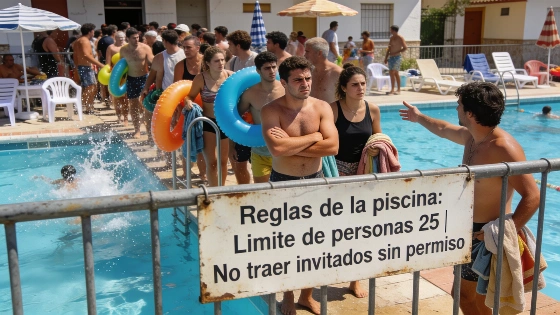
Summer brings a surge in complaints about overcrowded community pools. Spanish law allows action against owners who regularly bring too many guests. Communities can set their own rules to manage access.
With the arrival of summer, community swimming pools across Spain are once again at the center of neighborhood disputes. The most frequent source of tension is owners who repeatedly bring large groups of guests, leading to overcrowding and frustration among other residents. This recurring issue has prompted many communities to look for legal solutions to protect shared spaces.
Spanish law, specifically the Ley de Propiedad Horizontal (LPH), provides a framework for managing the use of communal facilities. According to Article 9 of the LPH, all owners have the right to use common elements like pools, but must do so in a way that does not prevent others from enjoying the same rights. Systematically inviting excessive numbers of guests can directly violate this obligation, especially when it limits space or capacity for other residents.
However, the law does not specify a maximum number of guests per household. Instead, Article 6 of the LPH allows each community to establish its own internal regulations, including guest limits, through a simple majority vote at the owners' meeting. If a resident repeatedly breaks these internal rules, Article 7.2 of the LPH enables the community to issue a formal warning and, if necessary, take the matter to court to stop disruptive behavior.
In cases where a community has not set specific internal rules about guests, the situation becomes less clear. The most effective approach is to raise the issue at the next owners' meeting and approve a concrete regulation. Until such a rule is in place, communities can still act under Article 7.2 if guest-related problems cause noise, overcrowding, or damage to facilities, without waiting for new regulations to be adopted.
Spain has seen a steady increase in the number of residential complexes with shared amenities, especially in urban and coastal areas. As a result, the management of communal spaces has become a key issue for property owners. The LPH, first enacted in 1960 and updated several times since, remains the main legal reference for resolving conflicts in multi-owner buildings. While the law gives communities flexibility to adapt rules to their needs, it also places responsibility on owners to respect shared spaces. In practice, clear internal regulations and effective communication among residents are often the best tools for preventing disputes before they escalate to legal action.