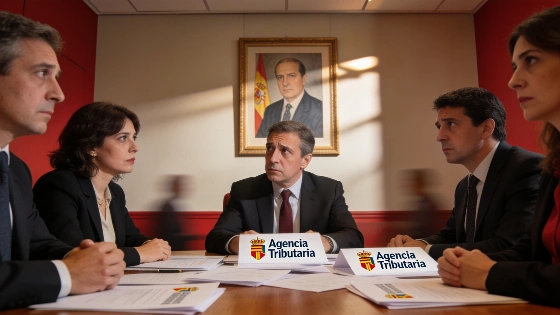
A wave of resignations at the Agencia Tributaria has sparked unease among staff. The appointment of Antonio Ansón as director general raises fears of political influence. Inspectors and technicians demand guarantees of independence.
The sudden resignation of the Agencia Tributaria’s top management has triggered deep concern among its staff, as Antonio Ansón steps in as the new director general. The move follows a series of departures linked to disagreements with the Ministry of Finance, fueling anxiety that the agency’s leadership may now shift from a technical to a more politically driven approach. Many employees worry that Ansón, who previously served as chief of staff to the Secretary of State for Finance, Jesús Gascón, could be more willing to implement controversial changes that his predecessor, Soledad Fernández, resisted.
Ansón’s appointment comes at a sensitive moment. Gascón, now the number two at the Ministry of Finance, has repeatedly advocated for a new tax management model that would give Spain’s autonomous communities a greater role in tax administration. This includes proposals to extend arrangements similar to those negotiated with Catalonia, allowing regional tax offices to gain more competencies, such as verifying regional tax deductions. The prospect of fragmenting the Agencia Tributaria’s structure has become a central point of tension, with many inside the agency fearing a loss of unity and operational integrity.
Staff members express particular unease about Ansón’s management style, recalling his previous roles in human resources where he was seen as less responsive to employee concerns. Some believe his close alignment with Gascón could mean he will prioritize political directives over the agency’s traditional independence. One official noted that if Fernández stepped down to avoid being associated with the agency’s potential fragmentation, Ansón might be more willing to carry out such changes, even if only for a short period.
In response to the leadership change, the association of Inspectores de Hacienda del Estado has publicly called on Ansón to defend the integrity of the Agencia Tributaria. They urge him to resist external interference, prevent any division of the agency or its resources, and protect staff from forced transfers or restrictions on mobility. The inspectors have requested an immediate meeting to voice their concerns directly and insist that the agency’s organizational autonomy and personnel selection processes remain untouched. Their statement ends with a warning that they will closely monitor any steps by the new leadership that could undermine constitutional principles of equality and solidarity.
The Gestha union, representing the largest group of tax technicians, echoes these concerns. They stress the importance of maintaining the agency’s unity and call on Ansón to address longstanding issues related to staffing structure, job allocation, and career development. Gestha’s president, Javier Gómez Vergel, emphasizes that any move toward a networked model of regional tax agencies must preserve the integrity of the Agencia Tributaria’s personnel and legal competencies. He also urges the new director to halt the organizational decline and resolve the frustration among staff, describing the agency as a pillar of the Spanish state in need of stable solutions.
This leadership crisis at the Agencia Tributaria comes amid broader debates over the future of Spain’s tax system and the balance of power between central and regional authorities. The government’s recent proposals to reform regional financing and tax collection have sparked similar controversies in other institutions. For example, recent tensions within the Ministry of Finance have also been highlighted in the context of high-profile cases, such as the situation involving María Jesús Montero and Vicente Fernández, as reported in coverage of internal oversight challenges at SEPI. These developments underscore the ongoing struggle to balance political priorities with institutional independence in Spain’s public administration.
The Agencia Tributaria, established in 1992, is responsible for tax collection and enforcement across Spain. Its independence has long been considered crucial for ensuring fair and effective tax administration. Any significant changes to its structure or autonomy could have far-reaching implications for public finances, regional relations, and the confidence of both staff and taxpayers. As the new leadership takes shape, the agency faces a critical period that may redefine its role within Spain’s fiscal landscape.