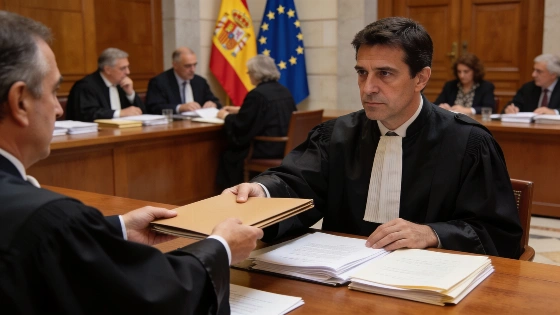
A conservative judge's attempt to uphold the Supreme Court's refusal of amnesty for Carles Puigdemont is likely to fail. The Constitutional Court's progressive bloc is expected to reject the draft, which could reshape the legal outlook for Catalan leaders.
The Constitutional Court is preparing for a direct confrontation as conservative magistrate José María Macías tries to uphold the Supreme Court's refusal to grant amnesty to Carles Puigdemont and other Catalan leaders. Macías, a vocal opponent of the amnesty law, has circulated a draft ruling that supports the Supreme Court's argument: those convicted in the ‘procés’ should not receive amnesty if they personally benefited from misusing public funds. According to EFE, Macías's draft closely follows the Supreme Court's view that amnesty does not apply when the court sees personal gain from public resources.
But this draft is unlikely to stand. The Constitutional Court's progressive majority is expected to reject Macías's proposal at the plenary session scheduled for September 22, 2026, with Jordi Turull's appeal as the first test case. Several Spanish media outlets, citing court sources, report that the progressive bloc plans to dismiss the draft and appoint a new rapporteur, signaling a shift in how the amnesty law is interpreted.
The Supreme Court has indicated it will wait for the Constitutional Court's decision on Turull before making final determinations on amnesty for Puigdemont and Junqueras, with late October seen as a key timeframe for next steps.
Macías's draft argues that the benefit was not just about increasing personal wealth, but also about avoiding personal expenses. The text claims that public officials kept their own assets intact, while ordinary citizens who donated to the cause lost money. The proposal frames this as personal benefit, which would justify denying amnesty. This reading is at the heart of the dispute, as the Supreme Court insists that amnesty should not be granted if there is personal enrichment through public funds.
The progressive bloc sees it differently. They argue that the Supreme Court's refusal to apply the amnesty law violated the fundamental rights of the ‘procés’ leaders. Their position is that using public funds, while controversial, does not amount to personal enrichment in the legal sense needed to block amnesty. This view is expected to shape the final ruling, which will affect Turull's appeal and set a precedent for other cases involving malversation charges from the Catalan independence movement. Reports from ARA and other Spanish outlets suggest the outcome could open the door to amnesty for other high-profile figures, including Puigdemont, Oriol Junqueras, Dolors Bassa, and Raül Romeva.
Macías, who previously opposed the amnesty law as a member of the General Council of the Judiciary, will remain as rapporteur for the case. He will now have to draft a new proposal that reflects the progressive majority's position, reversing the initial conservative approach. The decision will have immediate consequences for Puigdemont and others, potentially allowing amnesty for those previously excluded on the grounds of alleged personal gain.
In a parallel development, Spain's Court of Auditors is also moving toward applying the amnesty law to several figures involved in the ‘procés’, reinforcing the broader legal shift surrounding this legislation. This process could affect more than 30 former officials and is seen as part of a coordinated legal response to the independence movement.
This legal dispute highlights the deep divisions within Spain's top courts over the aftermath of the Catalan independence push and the limits of political forgiveness. The Constitutional Court's decision will determine the fate of key separatist leaders and clarify how far the amnesty law can go. The progressive majority's likely rejection of the conservative draft points to a change in judicial interpretation, putting fundamental rights ahead of a strict reading of financial benefit.