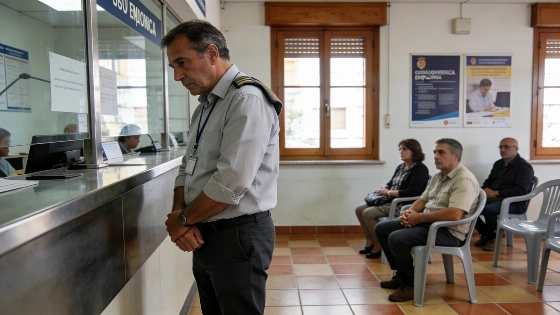
A court in the Canary Islands has ordered Social Security to compensate a civil servant for stress caused by understaffing. The case highlights failures in workplace risk prevention and ongoing tensions in public offices.
The Superior Court of Justice of the Canary Islands has issued a precedent-setting decision against the Instituto Nacional de la Seguridad Social (INSS), holding it responsible for failing to protect an employee from work-related stress at its Santa Cruz de La Palma office. The ruling, which overturns a previous verdict, obliges the INSS to pay €15,000 in damages to Iria Campelo, a senior staff member, after finding that chronic understaffing and lack of effective preventive measures violated her fundamental rights.
The case centers on the period during and after the COVID-19 pandemic, when the office operated with just six employees. In-person appointments were drastically reduced, leaving many local residents unable to access services. According to Campelo, the majority of available phone appointments were booked by people from outside La Palma, mainly from Tenerife, and sometimes even from mainland Spain. This left island residents without access to essential services, while staff faced mounting pressure and, at times, aggressive behavior at the office entrance.
Repeated requests for additional support and changes to the appointment system were rejected by management, who cited higher-level directives and refused to negotiate. As a result, Campelo and two colleagues began to skip some phone appointments, arguing that limited resources should be focused on local needs. This led to disciplinary action, with Campelo receiving a suspension of employment and pay for six weeks.
Campelo and a colleague then filed a lawsuit against the INSS, alleging violations of Spain’s workplace risk prevention laws. The initial court ruling dismissed their claims, stating that the workload was not proven to be excessive and attributing the situation to structural budget constraints rather than negligence. However, the higher court disagreed, stating that chronic resource shortages do not absolve public employers of their duty to ensure safe and healthy working conditions. The court emphasized that merely formal compliance with regulations is insufficient if real and effective preventive measures are lacking.
The ruling is considered groundbreaking because it recognizes that psychosocial risks, such as stress from overwork in public administration, can amount to a violation of fundamental rights when preventive obligations are not met. The court not only declared the INSS in breach but also ordered it to implement effective preventive measures. Legal experts note that this decision could influence similar cases in the future, as another lawsuit from the same office is still pending.
Despite the legal victory, Campelo reports ongoing difficulties at work, including social isolation and lack of support from colleagues. She remains on medical leave and has requested a transfer. The INSS maintains that it acted in accordance with regulations and has appealed the decision to the Supreme Court. The Ministry of Social Security points to a recent recruitment drive, with nearly 9,500 new positions authorized since 2020, aimed at addressing staff shortages and improving service quality, especially in the islands.
Spain’s public sector has faced persistent challenges with staffing and service delivery, particularly in remote regions like the Canary Islands. The pandemic intensified these issues, exposing gaps in digital access and the limits of remote service models. The court’s decision underscores the legal obligation of public employers to go beyond formal compliance and actively safeguard the well-being of their employees, even in the face of structural constraints. As the case moves to the Supreme Court, its outcome may set a new standard for workplace protections in Spain’s public administration.