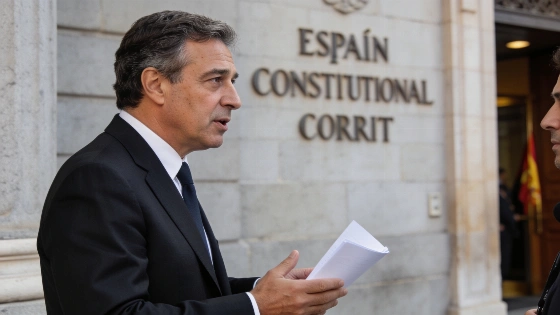
Spain’s Constitutional Court has applied the amnesty law to the embezzlement conviction linked to the procés. The decision removes the legal barrier that had blocked a possible return for Carles Puigdemont.
The Constitutional Court has applied Spain’s amnesty law to the embezzlement offence linked to the procés. That ruling contradicts the interpretation adopted by the Supreme Court and opens a legal route for Carles Puigdemont to return to Spain. Cándido Conde-Pumpido says the court had to apply the law according to its constitutional meaning.
Speaking to EL PAÍS, the president of the Constitutional Court described the outcome as constitutional review rather than a political choice. He rejected the claim that the Supreme Court acted improperly. In his account, the Supreme Court followed a legally consistent interpretation of its own, while the Constitutional Court later decided that interpretation was not the most appropriate one.
The Constitutional Court approved the amnesty interpretation by seven votes to five, with five judges issuing dissenting opinions. The split highlights the depth of the judicial disagreement over the scope of the amnesty law.
That distinction sits at the centre of the dispute. Conde-Pumpido argues that changing a judicial ruling does not imply misconduct by the judges who issued it. The case turns on how the amnesty law should be read and which interpretation complies with the Constitution.
The Constitutional Court also ordered the Supreme Court to reconsider the case of former Catalan official Dolors Bassa. It found that the exclusion for cases involving “personal enrichment” had been interpreted too broadly. The court’s published account says personal enrichment is distinct from the property-related element formally present in embezzlement. The exclusion is meant to cover private corruption unrelated to financing the independence process, rather than automatically removing every embezzlement offence from the amnesty.
That shift puts Puigdemont’s return within reach.
The ruling does not describe a political agreement or guarantee an immediate return. It removes the interpretation that had kept the embezzlement conviction outside the amnesty framework.
Accusations of partisanship have followed the decision. Conde-Pumpido rejects them and says judges must accept that their decisions may later be changed. He argues that challenging the Constitution also means challenging democracy.
The Supreme Court has five days to receive allegations and arguments from the parties after being notified of the Constitutional Court’s decision. Judge Pablo Llarena has meanwhile temporarily lifted the national arrest warrants for Puigdemont, Antoni Comín and Lluís Puig, but that measure does not itself finally apply the amnesty or close the criminal proceedings.
The political and judicial background was covered in an earlier Puigdemont report focused on the uncertainty surrounding his return. This ruling changes that legal position by establishing the Constitutional Court’s preferred reading of the amnesty law in the malversation case.
Conde-Pumpido also rejects the term lawfare for Spain’s judicial conflicts. He says the country faces the judicialisation of politics through organisations dedicated to that purpose. He argues that European countries generally do not allow political parties to participate directly in criminal proceedings.
His comments also address the crisis in Ceuta. Conde-Pumpido considers rejection at the border constitutional. His position is that anyone who crosses illegally from Africa into the European Union must be returned immediately without further procedures. He says that approach has been endorsed by the European Court of Human Rights and Spain’s Constitutional Court.
The interview links the amnesty dispute to the state’s authority at its external border. In both matters, Conde-Pumpido presents the court’s role as enforcing constitutional standards rather than settling political disputes.
The Constitutional Court has displaced the Supreme Court’s interpretation of malversation under the amnesty law. Puigdemont’s return is legally possible under that reading, although the final status of the amnesty and related legal issues still depends on later Supreme Court decisions. The change affects prominent procés cases while leaving the Supreme Court’s conduct formally defended. The ruling changes the legal route available to those convictions.