A meteorologist told a Valencia court that regional authorities had real-time data on the 2024 dana disaster. This contradicts the official claim that a lack of information delayed the response. The testimony could reshape the investigation.
The investigation into the catastrophic dana that struck Valencia on October 29, 2024, has taken a new turn after a meteorologist testified in court that the Generalitat Valenciana had access to real-time data as the disaster unfolded. This revelation directly challenges the long-standing official narrative that regional authorities failed to act promptly due to a lack of timely information about the scale of the flooding, which claimed 230 lives.
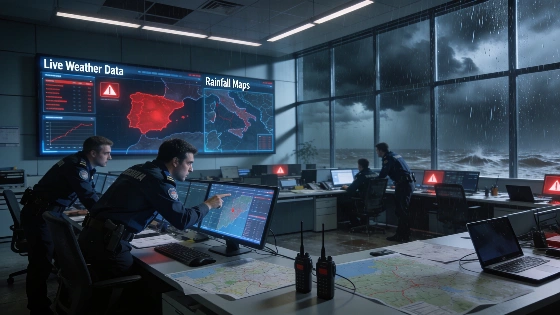
According to the testimony before Judge Nuria Ruiz Tobarra in Catarroja, staff at the Centro de Coordinación de Emergencias were continuously receiving detailed meteorological data from the Asociación Valenciana de Meteorología (Avamet). The system, which aggregates rainfall and weather variables from 900 stations, provided a constant stream of updates. The expert described the volume of information as overwhelming, noting that operators could spend hours monitoring the evolving situation.
Five days before the disaster, meteorological models had already indicated the likelihood of torrential rains on October 29. This prompted calls for a monitoring meeting, which was eventually held on the eve of the dana. During that meeting, Juan Ramón Cuevas Camps, head of the Risk Analysis and Monitoring Unit at the emergency center, acknowledged the complexity of the situation expected for the following day.
On the morning of the disaster, the first convective storm line formed in La Ribera before the national weather agency Aemet issued a red alert. By 12:40, rainfall had reached 160 liters per square meter, surpassing records set during the infamous Tous dam incident in 1982. The meteorologist compared the 2024 event to both the Tous disaster and the 1957 flood, emphasizing their similar meteorological profiles.
As the afternoon progressed, the intensity of the flooding increased sharply. Between 15:00 and 17:00, rainfall rates soared, with some areas recording 100 liters per square meter in just one hour—far above the threshold for torrential rain. The risk became concentrated along the Magro River and the Poyo ravine, which devastated towns like Paiporta and Catarroja, resulting in dozens of fatalities in each municipality.
All this data was displayed in real time on a large screen at the emergency coordination center, alongside information on road conditions and the volume of emergency calls. On the day of the dana, the Generalitat's 112 hotline logged nearly 20,000 communications, reflecting the scale of the crisis.
The meteorologist's account undermines the so-called "information blackout" theory, which has been the cornerstone of the Generalitat and Partido Popular's defense for the past 19 months. They have argued that the Mazón administration could not act sooner because agencies under the central government, such as Aemet and the Confederación Hidrográfica del Júcar (CHJ), failed to provide timely warnings. This line of defense has also been supported by former high-ranking officials under investigation, including ex-Justice and Interior Minister Salomé Pradas and former Emergencies Director Emilio Argüeso. However, the presiding judge has repeatedly questioned this argument in her rulings, as noted by El País.
The controversy over the authorities' response to the 2024 dana has sparked broader political and legal debates in Valencia. Similar disputes over official testimony and accountability have emerged in other recent cases, such as the legal action considered against Vicent Mompó regarding his statements on the emergency response, as reported in coverage of the Compromís party's challenge.
Spain has a long history of devastating floods, with the 1982 Tous dam failure and the 1957 Valencia flood serving as grim reminders of the region's vulnerability. The dana of 2024 stands out not only for its human toll but also for the questions it raises about crisis management and the use of advanced meteorological data. The ongoing judicial inquiry is expected to clarify whether the available information was adequately used and if earlier action could have mitigated the tragedy's impact. The outcome may influence future protocols for emergency response across the country.