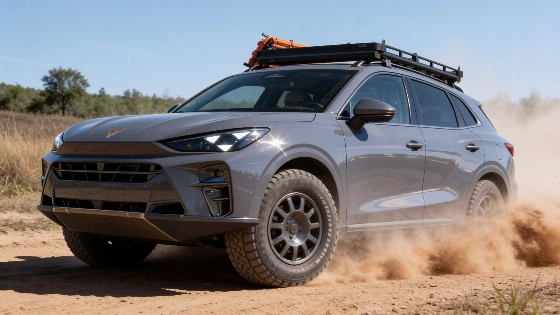
Cupra has revealed the Terramar VZ Desert, a heavily modified one-off built to handle the punishing conditions of the Classics Africa 2026. With raised suspension, off-road wheels, and a reinforced body, this SUV is set for a true test in the Moroccan desert.
The Cupra Terramar VZ looks nothing like its city-going relatives after gaining 60 millimeters of extra ground clearance and a set of Dakar-spec wheels. This isn’t a concept for the showroom. It’s a single, purpose-built SUV made for the Classics Africa 2026—a rally where sand, rocks, and heat expose every mechanical flaw. Spanish automotive outlets report that the Terramar VZ Desert was engineered specifically for this event and won’t be sold as a production model, making it a true one-off in Cupra’s range.
Most of the original running gear remains: the 2.0 TSI engine, 265 horsepower, and 4Drive all-wheel drive system are unchanged. The real changes are underneath and around the car. It rides on custom Nadaltech by SH suspension, Braid FullRace T Dakar 16-inch wheels, and BFGoodrich All Terrain T/A KO2 tires with a thick 75 profile. These aren’t just for looks. The upgrades help the SUV absorb impacts, run lower tire pressures on sand, and protect the rims from rocks—key for a rally where a single puncture can end the day.
The Terramar VZ Desert's total weight after rally preparation increased to 1,952 kg, about 200 kg more than the standard model, due to added safety and durability features.
Surviving the Sahara takes more than brute force. Cupra’s engineers added a dedicated gearbox radiator, expecting hours of slow driving in 40-degree heat. The transmission, often the first thing to fail in desert rallies, now has its own cooling system. Underbody armor at the front and rear shields vital parts from rocks and ruts. Mud flaps and a safari roof rack loaded with recovery gear—MaxTrax boards, shovel, air jack, straps, compressor—prepare the Terramar for the moments when it gets stuck and digging out is the only option. Automotive outlets note that these changes focus on reliability and self-recovery, matching the rally’s emphasis on endurance over speed.
Inside, comfort takes a back seat to survival. The cabin gets bucket seats, a full roll cage, four-point harnesses, and a 2 kg fire extinguisher. All these additions push the weight up to 1,952 kg—over 200 kg heavier than the standard Terramar VZ. In the desert, safety and toughness matter more than lap times.
The rally itself is a five-stage loop around Erfoud and Merzouga, mixing rocky tracks, dry riverbeds, and dunes. On rocks, the suspension and tires take a beating. In the dunes, the challenge is to keep moving and avoid getting stuck. The Terramar VZ Desert isn’t built for top speed—its 0–100 km/h in 5.9 seconds and 243 km/h maximum are beside the point here. What matters is lasting through the punishment and adapting when the terrain turns against you.
Classics Africa 2026 will take place from September 13 to 18 in the Erfoud and Merzouga region of Morocco, featuring a prologue and five stages across mixed terrain including rocky tracks, dry riverbeds, and dunes. The rally is structured as a regularity and navigation raid rather than a pure speed competition, which is why Cupra prioritized reliability, cooling, and self-recovery equipment in the Terramar VZ Desert.
This isn’t Cupra’s first time building for the desert. In 2023, the brand entered the Seat Ateca Marathon, another city SUV reworked for off-road use, following a trend seen elsewhere. It’s a similar approach to what Australian builders did with the Toyota HiAce, as reported earlier, turning a standard van into a true outback explorer with heavy-duty upgrades.
What makes the Terramar VZ Desert different is that it keeps its standard engine and transmission, relying on targeted reinforcements to survive the rally. Cupra is betting that its production-spec drivetrain, with the right tweaks, can handle the same abuse as purpose-built rally cars. If the SUV finishes the Classics Africa 2026 without major failures, it will show just how tough Cupra’s engineering really is. Automotive sources see the Terramar VZ Desert’s entry as a calculated move to prove the durability of Cupra’s standard components under extreme conditions.
For Spanish automakers, the desert is a place to prove their cars can do more than city driving. The Terramar VZ Desert’s overhaul isn’t just about technical upgrades—it’s a way for Cupra to show it can compete in endurance rallies. If the car survives Morocco’s extremes, it will send a clear message: Spanish SUVs can handle more than just pavement, and Cupra is willing to put its reputation to the test.