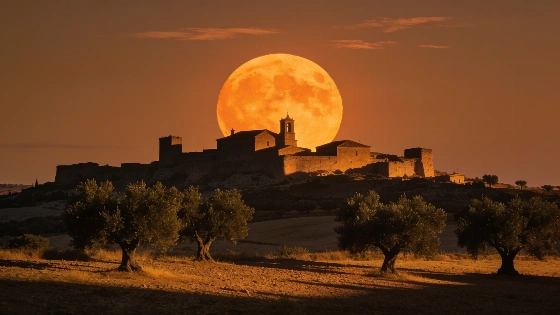
On July 29, the Deer Moon will become the first full moon of summer in Spain. The event offers a rare visual effect at moonrise. Observers can expect a striking orange glow and a larger-than-life appearance.
This Wednesday, July 29, Spain will witness the Deer Moon, the first full moon of the summer season in the northern hemisphere. The lunar event, set to peak at 14:37 GMT according to NASA, will be most impressive at dusk as the moon rises in the eastern sky. While not classified as a supermoon, its timing and visual impact make it a highlight for skywatchers across the country.
As the sun sets, the Deer Moon will appear with a distinct orange or golden hue, a result of the Earth's atmosphere filtering its light. This effect, combined with the well-known lunar illusion, will make the moon seem unusually large when it is close to the horizon. The phenomenon is purely psychological, caused by the brain comparing the moon to nearby objects like buildings or trees. Once the moon climbs higher, it returns to its usual apparent size.
The name 'Deer Moon' has roots in North American indigenous traditions, marking the period when male deer begin to regrow their antlers. Over time, this term has become widely recognized and is now part of the popular calendar of full moons. Other cultures have their own names for July's full moon, such as Thunder Moon, Hay Moon, Salmon Moon, Raspberry Moon, and Midsummer Moon, each reflecting local natural cycles and agricultural activities.
For those hoping to observe the Deer Moon, no special equipment is required. The best views will be from open areas with a clear eastern horizon shortly after sunset. Binoculars can enhance the view of lunar seas, while a small telescope may reveal prominent craters near the terminator. Photographers often favor the moment of moonrise, when the moon's low position allows for dramatic compositions with landmarks or natural features.
The Deer Moon will appear nearly full on both the night before and after its official peak, providing multiple opportunities for observation. Its brightness, however, may make it harder to see fainter celestial objects such as the Milky Way or meteor showers during these nights. Still, the full moon remains a central feature of summer evenings, drawing attention away from other astronomical events.
July's full moon is not the only natural spectacle affecting the region this season. Weather patterns, including rainfall and temperature shifts, have also shaped the summer experience, as highlighted in recent reports on changing conditions in other parts of the world, such as Delhi's forecast for moderate rainfall and rising temperatures.
In Spain, the Deer Moon offers a reminder of the enduring fascination with the rhythms of the night sky. The event is accessible to all, requiring only a clear evening and a view to the east. As the first full moon of summer, it stands out as a moment to pause and appreciate the regularity and beauty of celestial cycles that have captivated people for generations.
For context, the full moon occurs when the Earth is positioned directly between the sun and the moon, allowing the lunar surface to be fully illuminated. While the Deer Moon does not bring any changes to rules or daily life in Spain, it remains a significant date for astronomy enthusiasts and anyone interested in natural phenomena. The next notable lunar events will follow the established calendar, with each full moon carrying its own traditional name and seasonal significance.