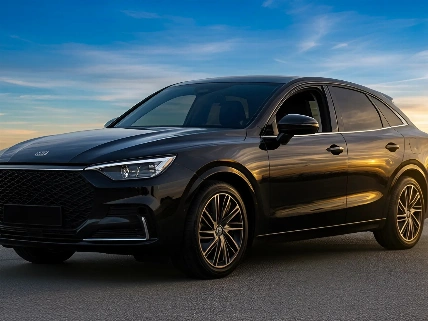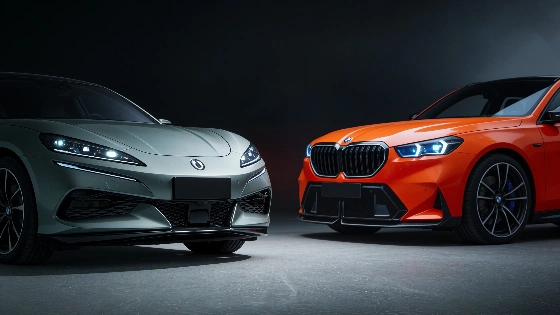
BMW’s long-standing position as the family sports sedan benchmark now faces a challenge from Denza, whose Z9 GT arrives in Spain with more power and a lower price. The Chinese brand is taking on the German model on several fronts.
The first thing you notice is the size. The Denza Z9 GT is 5,195 mm long, making it longer and wider than the BMW M5, which measures 5,096 mm. The Denza also has more boot space, with 478 liters compared with the M5’s 466 liters. For even more room, the M5 Touring offers 500 liters, or up to 1,630 liters with the rear seats folded down.
Recent industry reports put the Denza Z9 GT’s front trunk (frunk) capacity at 53 liters, adding to its practicality for family use. The model has a 3,125 mm wheelbase and, in its EV version, can accelerate from 0 to 100 km/h in as little as 2.7 to 3.0 seconds. It is part of BYD/Denza’s international expansion, with a debut in Bangkok on September 16, 2026, reflecting the brand’s ambitions beyond China.
The real battle is under the hood. The BMW M5 is now a plug-in hybrid, with a 4.4-liter TwinPower Turbo V8 (544 CV) and an electric motor (197 CV) producing a combined 727 CV and 1,000 Nm of torque. The setup takes the M5 from 0 to 100 km/h in 3.5 seconds. Its top speed is 250 km/h, and its electric-only range is less than 70 km, supported by an 18.6 kWh battery.
The Denza Z9 GT comes in two versions. The Super DM plug-in hybrid pairs a 2.0-liter turbo petrol engine (325 CV) with three electric motors: one up front (272 CV) and two at the rear (300 CV each). Together, they produce 776 CV. This version accelerates from 0 to 100 km/h in 3.6 seconds and reaches a top speed of 260 km/h. The all-electric model uses three motors for a total of 1,156 CV, reaches 100 km/h in 3 seconds and has a top speed of 270 km/h.
Range and charging are another story. The Denza plug-in hybrid has a 63.82 kWh battery and claims more than 200 km of electric range and over 800 km combined. The electric version uses a 122.49 kWh battery and promises up to 600 km. Its FLASH Charging system, rated at 1,500 kW, can charge from 10% to 70% in five minutes, a figure few rivals can match. The BMW’s electric range and charging speed are well below that.
Price is where Denza lands its biggest punch. The Super DM hybrid starts at 103,500 euros, while the all-electric version costs 117,500 euros. Both are well below the BMW M5’s 167,600 euros for the sedan and 170,300 euros for the Touring. For Spanish buyers, the gap is hard to ignore.
The equipment lists show what each brand is aiming for. Denza equips the Z9 GT with 21-inch wheels, digital mirrors, advanced LED headlights, Crab Walk and Compass Turn 360° features, e³ Parking Assist, premium leather seats with massage and ventilation, a 20-speaker Devialet sound system, and a 50 W wireless charger. Safety and driver aids include adaptive cruise control, lane centering and collision braking. The BMW M5 counters with adaptive M suspension, M wheels, a panoramic sunroof, adaptive LED headlights, a heated M steering wheel, Merino leather, four-zone climate control, BMW Curved Display, Bowers & Wilkins audio and a full suite of advanced driver-assistance systems.
For Spanish families considering electrified SUVs, the Denza Z9 GT’s arrival recalls the shake-up when the Jaecoo 8 went up against the Skoda Kodiaq, as reported earlier. New brands are pushing established names to prove their worth beyond a famous badge.
On paper, the Denza Z9 GT looks like the better deal. It is bigger and more powerful, comes as a plug-in hybrid or an all-electric model, and offers more equipment and range for the money. The BMW still has strengths: its V8 engine and the feel of the M division are hard to match. For some buyers, that driving character matters as much as the numbers.
For buyers in Spain, the Denza Z9 GT broadens the choice beyond German brands, offering a different mix of performance, technology and value. The BMW M5 remains a favorite among driving fans, while Denza’s arrival is prompting buyers to reconsider what a high-performance family car should offer.