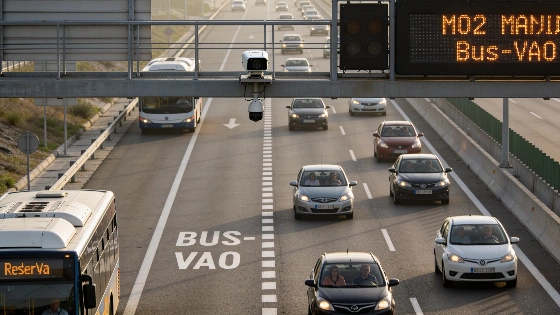
Madrid's A-2 now features a dynamic Bus-VAO lane, restricting access during peak hours to vehicles with at least two occupants. Drivers who ignore the rule risk a €200 fine, as the DGT enforces new surveillance measures. The system aims to ease congestion and speed up commutes.
Madrid commuters on the A-2 face a new reality: the left lane is now a dynamic Bus-VAO corridor, reserved during rush hours for buses, motorcycles, authorized vehicles, and cars carrying at least two people—including the driver. The Dirección General de Tráfico (DGT) has begun a trial phase that runs through August and the first week of September, with strict enforcement and €200 fines for those who break the rules.
The Bus-VAO system operates from 7:00 to 9:00 in both directions and from 15:00 to 17:00 heading out of Madrid. Outside these windows, the lane reverts to general use. Unlike the A-6 Bus-VAO, the A-2 version uses existing infrastructure—no separate roadbed or physical barriers—relying instead on illuminated beacons and digital signage to signal when restrictions are in force.
According to the DGT, the system is not a new “red lane” but a flexible management tool. The rules are dictated by real-time signage, not by the color of the pavement. Green beacons mark legal entry and exit points, while amber beacons indicate stretches where lane changes are forbidden. When the lights are off, the lane is open to all eligible vehicles.
The first phase covers 19.2 kilometers between Madrid and Torrejón de Ardoz, with plans to extend to Alcalá de Henares in a later stage. Entry and exit points are strictly defined: for inbound traffic, drivers can enter at Torrejón de Ardoz, Rejas, or Canillejas, but must continue to Avenida de América. Outbound, access is at Arturo Soria-Josefa Valcárcel or the Eisenhower junction, with exits at Canillejas or Rejas.
Only buses, motorcycles, authorized vehicles, and cars with at least two occupants may use the lane during restricted hours. The DGT stresses that this rule applies regardless of whether a car is electric or hybrid—zero-emission badges do not grant automatic access. Exceptions for single-occupant vehicles with environmental stickers are only allowed if expressly indicated by variable message panels, which is not the case during the current trial.
Ten intercity bus lines, including routes 223, 224, 224A, 226, 227, 229, 261, 281, 282, and 283, are participating in the trial, offering express service between Madrid and surrounding municipalities such as Alcalá de Henares, Torrejón de Ardoz, Coslada, San Fernando de Henares, and Mejorada del Campo.
Surveillance is central to the system. Cameras automatically read license plates and use sensors to count vehicle occupants, ensuring compliance with both vehicle type and entry/exit rules. Violations—such as driving solo in the lane or entering/exiting at unauthorized points—are classified as serious under Article 76 of the traffic law, carrying a €200 penalty.
The DGT has made clear that the trial period is not a grace period. Enforcement is active from day one, with fines issued for any breach of the rules. The agency estimates that up to 15,000 daily travelers could benefit from the new lane, potentially reducing commute times by 25%. These figures are projections; the real impact will be assessed after the trial concludes.
For context, the issue of traffic regulation and enforcement is not unique to Spain. In France, for example, a recent court case highlighted the consequences of overstepping legal boundaries in rental agreements, as detailed in this report on a French landlord's failed eviction attempt.
As the DGT continues to refine the Bus-VAO system, drivers are urged to pay close attention to signage and lane markings. The success of the initiative—and the avoidance of costly fines—depends on public awareness and compliance with the new rules.