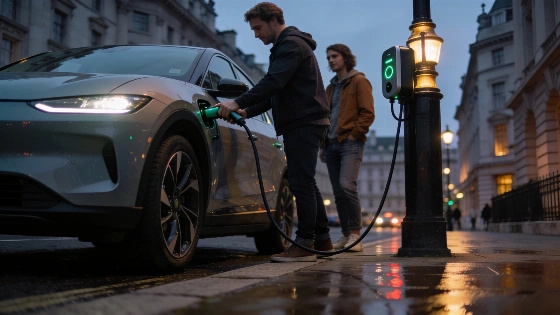
Some Spanish parking operators have tried to block electric cars over fire fears. But consumer advocates and industry leaders say the law not only allows electric vehicles but actively encourages their presence and charging infrastructure.
For several months, a public parking lot near Madrid’s Plaza Mayor displayed a sign warning that electric vehicles were not allowed inside because of “fire risk.” That sign has since been removed. According to a staff member, the city council now permits electric cars on the upper levels after addressing concerns about wooden structures.
The Organization of Consumers and Users (OCU) has clarified the legal situation. After reviewing current regulations, the OCU says there is no legal basis for a general ban on electric vehicles in public or private parking garages. In fact, Spanish and European laws require the installation of charging points and promote electric mobility as part of the country’s energy transition. According to the OCU and industry sources, any restrictions are local exceptions, not national policy.
Spanish law requires at least one charging point for every 40 spaces in non-residential parking lots, and one for every 20 spaces in government buildings.
The Spanish Parking Association (ASESGA), which represents operators across the country, agrees. ASESGA says the right of admission is strictly limited and cannot be used to bar electric vehicles. Manuel Barrios Bel, ASESGA’s president, notes that their members follow both legal requirements and technical safety standards. He adds that any bans on electric cars are isolated cases, usually due to outdated facilities or misunderstandings, not industry policy. As reported by elperiodico.com, ASESGA has repeatedly stated that blanket bans are not supported by current regulations.
Fire safety rules, such as the Reglamento de Instalaciones de Protección Contra Incendios and the Código Técnico de la Edificación, do not distinguish between combustion and electric vehicles. Other parking regulations actually encourage installing electric chargers, making it clear that electric vehicles are expected in these spaces. The OCU points out that fire safety rules do not differentiate by vehicle type, and the legal framework is designed to support electric mobility.
European authorities have also addressed the issue. In 2025, the European Commission concluded that battery electric vehicle fires are no more common than fires involving combustion engines. The Commission advised that banning electric cars from covered parking for fire reasons is not logical and slows the adoption of cleaner technology. Only severely damaged vehicles might need special handling, not a general ban.
ASESGA, the Spanish Parking Association, has stated that the right to refuse entry cannot be used to discriminate against electric vehicles. Most bans are linked to outdated facilities or misinterpretations, not to any industry-wide policy.
Spanish law goes further. Real Decreto-ley 29/2021 requires non-residential public parking lots to install at least one charging point for every 40 spaces, and at least one if the lot has more than 20 spaces. Lawmakers clearly expect electric vehicles to be present in these garages. According to elindependiente.com, these measures are part of a broader effort to modernize Spain’s infrastructure and support sustainable transport.
The OCU does note that electric vehicles have specific risks related to lithium-ion batteries and charging. Thermal runaway incidents can cause fires that are harder to put out than those in gasoline cars. Still, the OCU says the actual risk of fire in an electric vehicle is 10 to 20 times lower than in a petrol car, a figure also cited by several industry analyses.
Parking operators who continue to block electric vehicles are not following the law and risk undermining Spain’s move toward sustainable mobility. As reported earlier, recent regulatory changes in Spain focus on modernizing infrastructure and protecting public interests, in both healthcare and transport.
Spain’s legal framework is clear: electric vehicles cannot be excluded from parking garages. The law, industry, and consumer advocates all support their integration. Any remaining restrictions are based on outdated fears, not current evidence or regulation.