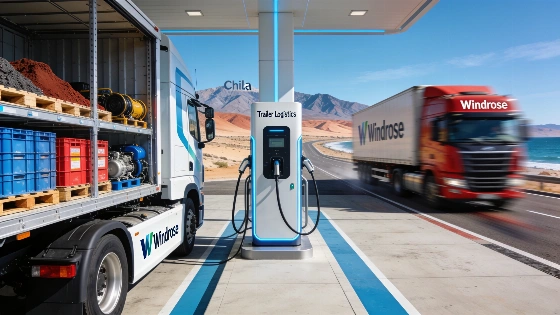
Electric trucks are making inroads in Chile’s logistics sector, with operational costs now matching or even beating diesel on high-mileage routes. Trailer Logistics is already running electric units for retail and mining giants, signaling a shift in the country’s heavy transport landscape.
When Hernán Searle, owner and general manager of Trailer Logistics, decided to introduce electric trucks into his Chilean fleet, he was betting on more than just environmental credentials. For Searle, the numbers now speak for themselves: electric trucks, once seen as a costly experiment, are beginning to outpace diesel rivals in operational efficiency for companies clocking serious mileage.
“Relying solely on oil is becoming a riskier proposition for heavy transport,” Searle explains. His company, which serves major retail and mining clients, has already put electric trucks to work on demanding routes. While the upfront price of an electric tractor unit remains higher—around $200,000 compared to $130,000–$180,000 for a new diesel model—the calculation is shifting. The real battleground is cost per kilometer, and here, electric is closing the gap fast.
Cost Per Kilometer: The New Metric
According to Searle’s data, a typical diesel truck in Chile burns through about 400 Chilean pesos per kilometer, factoring in fuel prices near 1,200 pesos per liter and an efficiency of 2–3 kilometers per liter. Electric trucks, by contrast, consume between 200 and 300 pesos per kWh, with an average usage of 1–1.3 kWh per kilometer. That translates to a potential saving of roughly 100 pesos per kilometer—provided the operator secures a favorable electricity rate.
The higher purchase price remains a hurdle, but Searle argues that for fleets running over 10,000 kilometers a month, the investment can pay off in as little as two to three years. This is a significant shift for an industry long dominated by diesel, and one that could reshape the economics of Chilean logistics.
Range and Charging: Overcoming the Distance Barrier
For long-haul operators, range anxiety is a real concern. Searle notes that a typical highway driver in Chile covers 500 to 700 kilometers per day, making short-range electric trucks impractical for many routes. Trailer Logistics has turned to Windrose, whose E670 model features a 705.2 kWh LFP battery, a loaded range of 670 kilometers, and a consumption rate of 1.05 kWh per kilometer. The truck is certified for use in Europe, the US, China, Chile, and Australia, and supports both MCS and CCS fast-charging standards.
Infrastructure is also catching up. Enel X has announced plans for Chile’s first high-power electric highway for trucks along the Ruta 5 Sur, with ultra-fast charging stations up to 600 kW between Santiago and Chillán, set to open in May 2026. This development could be a game-changer for logistics companies looking to expand their electric fleets.
Early Adoption: Retail and Mining Lead the Way
Trailer Logistics currently operates a fleet of 50 trucks, including two electric units on trial. One serves major retailers like Cencosud, Walmart, and Tottus in central Chile, while the other hauls copper for Codelco from Antofagasta to port. Despite these advances, the electric truck market in Chile is still in its infancy—just a handful of units are on the road, compared to 156,000 diesel trucks recorded by the INE in 2021. Searle expects that number to rise to around 50 electric trucks by early next year.
For Searle, the real risk now lies in sticking with diesel as the sole energy source. Oil price volatility can erode margins and complicate contracts with clients, making diversification not just a green choice, but a strategic one.
Chile’s evolving transport sector mirrors broader trends in sustainable logistics, much like the region’s agricultural innovations—such as the celebrated tomato harvests in Málaga’s Guadalhorce Valley, which have become a focal point for local producers and culinary events, as highlighted in this feature on Málaga’s signature tomato season.
As electric truck technology matures and infrastructure expands, the balance of power in Chilean heavy transport is shifting. For companies willing to invest, the road ahead may soon be both cleaner and more cost-effective.