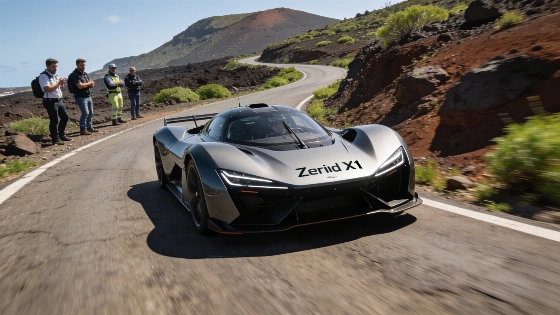
Pablo Suárez drove the all-electric Zeroid X1 to second place at the Subida de La Cumbre, marking the first time an electric car has reached the podium in a traditional Spanish mountain race.
Pablo Suárez did more than just show up at the Subida de La Cumbre—he changed the conversation in Spanish motorsport. In a race usually ruled by combustion engines, Suárez took the electric Zeroid X1 to a second-place finish in the tourism category, beating out several established competitors. The result wasn’t just a personal win; it put electric cars squarely in the mix for serious racing in Spain.
The Zeroid X1’s first outing was anything but low-key. On the 25th anniversary of El Hierro’s well-known hill climb, a race famous for its tough course and long history, the electric prototype lined up against some of the region’s top cars. Suárez, who knows the Zeroid best from Rallycross, admitted he was surprised by how well it handled the mountain. After the race, he said, "More important than the result is proving that combustion and electric cars can compete side by side."
The Zeroid X1, originally developed for the FIA RX2e Rallycross Championship, features 360 horsepower, 510 Nm of torque, dual independent motors, a 33 kWh battery, and a carbon-composite body on a tubular chassis.
This wasn’t a fluke. The Federación Canaria de Automovilismo (FCA), along with the Canary Islands’ Department of Ecological Transition and Energy, has spent nearly a year working to bring electric vehicles into the spotlight. Until now, their efforts were limited to safety cars and demo laps. The Subida de La Cumbre was the first time a fully electric car entered official competition in Spain, and the Zeroid X1 didn’t just participate—it was a real contender.
Officials took notice. Miguel Ángel Domínguez, acting president of the FCA, called the result proof that sustainability and top-level racing can go hand in hand. "Seeing a 100% electric vehicle fight for the podium against rally and hill climb regulars is a leap forward for road racing, just as Formula-E has changed the game on circuits," Domínguez said.
The choice of El Hierro as the venue was intentional. The island is already known for its focus on renewable energy, making it a fitting place for this kind of debut. Local government, the FCA, and the Escudería Hierro-Sur worked together to make sure the Zeroid X1’s entry was more than just a show—it was a step toward bringing electric cars into mainstream motorsport.
Before its competitive debut, the Zeroid X1 spent nearly a year serving exclusively as a safety car at tarmac events in the Canary Islands. Its transition to official race entry at Subida de La Cumbre was seen by local media as a historic step for both the region and Spain as a whole.
Lauren García and Angel Bello took wins in their categories, but it was Suárez and the Zeroid X1 who drew the most attention. Their next test comes soon at the La Palma round of the Campeonato bp de Canarias de Montaña-CCM. As reported earlier, the shift to electric isn’t just about city cars or luxury models—motorsport is now part of the story.
Spanish racing has changed quickly in recent years, from hosting World Rally Championship events to trying out alternative energy competitions. The FCA’s work on infrastructure and licensing, along with more women joining the sport, has made the Canary Islands a leader in racing innovation. The Zeroid X1’s podium finish is the latest in a series of moves toward a more open and tech-forward future for Spanish motorsport.
The message from this debut is clear. The Zeroid X1’s success isn’t just about engineering—it signals to teams, sponsors, and fans that electric cars are now part of the competition. The era of combustion-only racing is fading, and those who adapt will shape what comes next for motorsport in Spain.