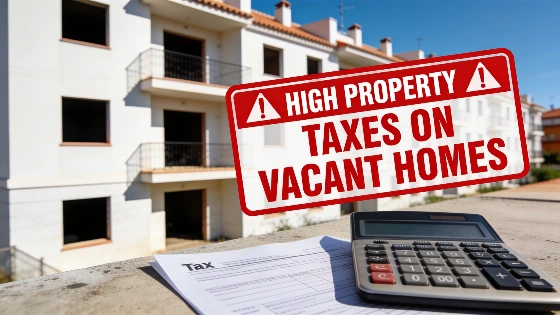
Spanish property owners with four or more homes left vacant for over two years could see their annual property tax bill soar by up to 150%. The decision to impose this surcharge rests with each local council, and strict conditions apply before any penalty is enforced.
Owners of multiple residential properties in Spain now face the prospect of a dramatic increase in their annual property tax bill if they leave homes empty for extended periods. Under current legislation, municipalities can impose a surcharge of up to 150% on the Impuesto sobre Bienes Inmuebles (IBI) for properties that remain unoccupied for more than two years, provided certain criteria are met.
This measure, introduced with the enactment of Law 12/2023 on the Right to Housing, is not an automatic penalty for owning a second home, nor is it a new rule for 2026. Instead, it has been in force since May 26, 2023, following amendments to the Local Treasury Law. The law specifically targets owners with four or more residential properties, aiming to discourage speculative vacancy and encourage the return of empty homes to the market.
Who Faces the Surcharge?
For a property to be classified as permanently vacant, it must have been unoccupied for over two consecutive years without a valid reason. The law exempts owners with only one or two homes, as well as those who can justify the vacancy—such as temporary work relocation, health issues, or ongoing renovations. Only individuals or entities holding at least four residential properties are subject to the potential surcharge.
Importantly, the decision to apply this penalty is left to each local council. Municipalities must explicitly include the measure in their fiscal ordinances, establish verification procedures, and formally declare a property as vacant before any surcharge is levied. As a result, the impact and enforcement of the rule can vary significantly across Spain.
How High Can the Surcharge Go?
Councils may initially set a surcharge of up to 50% of the standard IBI bill for properties vacant for more than two years. If the vacancy extends beyond three years, the penalty can rise to 100%. An additional 50 percentage points may be added if the same owner has two or more vacant properties within the same municipality, bringing the maximum possible surcharge to 150%.
For example, an owner with a standard IBI bill of €600 could face an extra €900 in surcharges, resulting in a total annual payment of €1,500—if the local council opts for the maximum rate and all legal requirements are met.
Exceptions and Valid Justifications
The law outlines several scenarios where a property will not be considered permanently vacant. These include temporary absences due to work or study, health-related relocations, or social emergencies. Properties undergoing renovation, those involved in legal disputes, and second homes (for up to four years of continuous vacancy) are also protected from the surcharge.
Additionally, homes actively listed for sale at market conditions for up to one year, or for rent for up to six months, are exempt. If these periods are exceeded, owners must provide further justification to avoid the penalty.
How Councils Prove Vacancy
Municipalities may use indicators such as the absence of registered residents or unusually low utility consumption to identify potentially vacant properties. However, these signs alone are not enough to impose the surcharge. Before any penalty is applied, the council must notify the owner, allow them to present evidence or explanations, and follow a formal process. The surcharge is assessed as of December 31 each year and is only charged after the vacancy is officially confirmed.
For property owners, these changes add a new layer of complexity to managing real estate portfolios. The move reflects a broader trend in Spain toward using fiscal policy to address housing shortages and speculative vacancy. For those interested in how other fiscal measures are shaping Spanish households, a recent analysis shows that the average minimum living income now exceeds €500 per household, with additional support for families with children. More details can be found in this report on Spain's minimum living income program.