The EU has invited Canada to become its first associated member. Trade between the two reached 130 billion euros in 2025, up 80 percent since 2016. Brussels aims to deepen economic and strategic ties amid shifting global alliances.
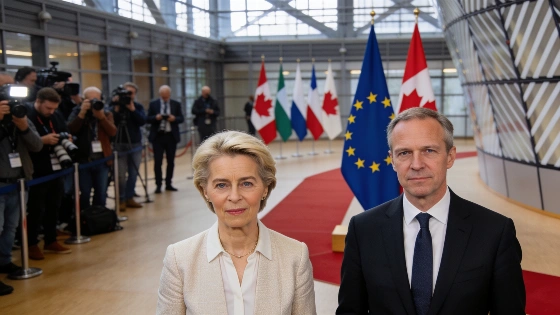
The European Union has proposed a new kind of partnership with Canada, inviting it to become the EU's first associated member. The offer comes as trade between the two reached 130 billion euros in 2025, an 80 percent increase since the CETA agreement was signed in 2016. European Commission President Ursula von der Leyen announced the proposal during her State of the Union address on September 16, 2026, with Canadian Prime Minister Mark Carney in attendance.
Carney, who has often criticized US trade policy under Donald Trump, was present for the announcement. As Canada moves away from its traditional reliance on the US, its relationship with Europe has become more important. The EU's invitation is more than a gesture; it reflects a response to the breakdown of the international rules-based order and a push to work more closely with countries that share democratic values. Still, as reported by Euronews and CBC, "associate member" status does not exist in current EU treaties, and the details—such as rights, voting power, and institutional structure—are yet to be worked out.
The official Canadian government release states that the EU was Canada’s second-largest trading partner in 2025, with total trade in goods and services reaching 178 billion Canadian dollars.
Trade figures show the scale of the shift. In 2025, goods and services traded between the EU and Canada totaled 130 billion euros, up from 72 billion in 2016. The CETA agreement, which removed most tariffs and made cross-border business easier, has played a major role. EU exports to Canada now stand at 48.8 billion euros, a 62 percent rise since 2016. Machinery, chemicals, and pharmaceuticals make up most of what Europe sends to Canada, while Europe mainly imports minerals and transport equipment from Canada. The EU has a 16 billion euro trade surplus in this relationship and is now Canada's second-largest trading partner, behind the US and ahead of China. According to the Canadian government, the total trade figure for 2025 is 178 billion Canadian dollars, which differs from the euro-based numbers often used in European reports.
The partnership goes beyond trade. Since 2017, the Strategic Partnership Agreement has guided joint work on climate, digital policy, and security. Both sides have committed to climate neutrality by 2050 and launched a Green Alliance in 2023 to coordinate environmental action. That same year, they signed a Digital Partnership to work together on artificial intelligence, cybersecurity, and digital skills. Von der Leyen has suggested moving from CETA to a broader "Alliance for the Future," which could include deeper defense industry ties and joint Arctic projects, though the specifics are still unclear. Reuters reports that the associate membership proposal is tied not only to political alignment but also to expanded cooperation in critical minerals, energy, AI, and defense.
Rising trade tensions with the US have pushed this shift further. After the Trump administration imposed tariffs on key partners, Canada responded in September 2025 with duties of up to 50 percent on hundreds of American products, including steel, motorcycles, cosmetics, and cheese. This has only strengthened the EU-Canada partnership. As reported earlier, Washington has threatened more trade action if Brussels and Ottawa move closer, raising the stakes for both sides.
Independent sources such as Reuters and CBC emphasize that the concept of 'associate member' is not defined in current EU treaties, and there is no legal framework for such a status. Discussions are ongoing, and the institutional details, including voting rights and formal mechanisms, have yet to be clarified.
For Spain and other EU countries, closer ties with Canada bring both economic opportunities and strategic advantages. The growth in trade, easier movement for workers and businesses, and the possibility of joint projects in defense and the Arctic all point to a partnership that is expanding beyond its original scope. While the exact terms of Canada's possible associated membership are still being discussed, the direction is clear. The EU's willingness to try new forms of partnership—especially with a G7 democracy like Canada—marks a practical shift in European strategy. As older alliances face new pressures, Brussels is looking to Canada as a key partner for its future economic and security plans.