The European Commission has publicly supported Morocco after thousands of migrants crossed into Ceuta. Brussels is now urging Spain to speed up returns and tighten border controls, exposing sharp divisions within the European Parliament.
The European Commission has come out in support of Morocco just as Spain’s border policy faces renewed scrutiny after the mass entry of migrants into Ceuta. The Commission’s decision not to blame Rabat comes as the European Parliament prepares to vote on a resolution condemning the use of migration as a political tool.
The main point of contention is the Commission’s backing of Morocco’s promise to take back everyone who entered Ceuta illegally, including unaccompanied minors and third-country nationals. Interior Commissioner Magnus Brunner made clear that Brussels wants to keep working with Rabat, even as many MEPs accuse Morocco of using the crisis for political leverage. According to data cited by Euronews, the Commission has approved €114.7 million in emergency aid to Spain at Madrid’s request, with the money going to border controls, reception, and migration management in Ceuta.
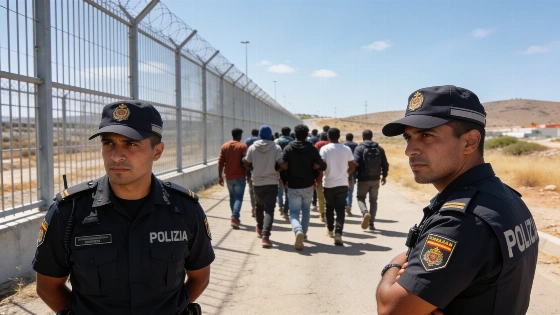
On July 30, 2026, approximately 80,000 people crossed from Morocco into the Spanish enclave of Ceuta, marking one of the largest mass border crossings in recent EU history.
EPRS/Think Tank
Brunner noted that illegal border crossings into the EU have dropped by half over the past two years, but said the Ceuta incident shows the need for stricter measures. The Commission now plans to step up its migration diplomacy, offering economic and trade incentives to partner countries, while also increasing Frontex surveillance, monitoring social media, and targeting human trafficking networks. According to EPRS, Spain officially asked for help from Frontex, Europol, and EUAA on August 28, 2026, to manage the situation in Ceuta.
Despite the Commission’s stance, the European Parliament is divided. All groups except the Spanish Socialists have agreed to negotiate the resolution’s text, but each will submit its own version, making a single consensus unlikely unless some factions back rival proposals or abstain. The draft resolution, seen by La Voz, not only condemns the use of migration as leverage but also criticizes Morocco’s statements on Spanish sovereignty over Ceuta and Melilla as incompatible with the obligations of a partner country. EPRS notes that the Commission has not activated the Digital Services Act "crisis" mechanism in response to online rumors about Ceuta, since no EU member state has formally requested it.
Morocco, meanwhile, has sent a mass email to MEPs blaming the Ceuta events on disinformation campaigns, echoing the Spanish government’s position. Rabat says it will accept all returnees from the city, citing the "nature, scale and complexity" of the border breach as justification for its response. According to Al Jazeera, Morocco's Ministry of Foreign Affairs denies any role in organizing the mass crossing and says there is no evidence of its involvement.
Within the EU, there is no unified approach to Morocco: some member states advocate for tougher migration policies and increased pressure on Rabat, while others focus on expanding financial support. The European Commission has already allocated €222 million to Morocco for migration management between 2021 and 2024, with an additional €190 million planned by the end of 2027.
Euronews
Spain now faces growing pressure from Brussels to speed up the identification and return of migrants in Ceuta and to implement the new European Pact on Asylum and Migration. The Commission’s approach is to reward cooperation with financial and commercial incentives, while also tightening border controls and surveillance.
This is not the first time migration has been used as a bargaining chip in Spain-Morocco relations. As reported earlier, migration control remains Rabat’s most effective tool for influencing Spanish and European policy, often overshadowing other diplomatic disputes.
The Commission’s willingness to overlook Morocco’s previous use of migration as leverage highlights the EU’s reliance on outside partners for border management. While Brussels presents its stance as pragmatic, Spain and the EU are left balancing security concerns with the need to maintain fragile alliances. The lack of unity in the European Parliament shows how migration remains a divisive issue, with real consequences for border cities like Ceuta and Melilla and for the credibility of EU migration policy.