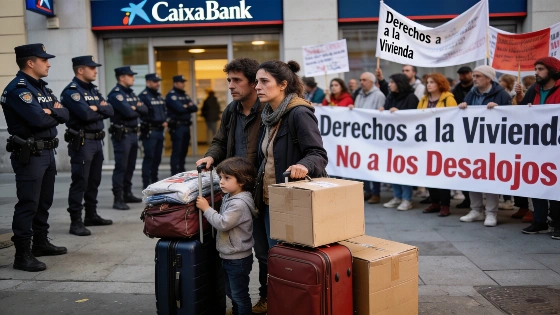
A family in Puente de Vallecas was evicted after months of delays. Activists responded by occupying a CaixaBank branch. The only housing offered was temporary shelter, sparking criticism from support groups.
The eviction of Adolfo, his daughter, and his four-year-old grandson from their home in Puente de Vallecas was carried out on Tuesday after several postponements and a last-minute extension. Despite ongoing negotiations and community mobilization, authorities proceeded with the fourth attempt to remove the family, who had been seeking a social rent agreement to remain in the property. The eviction triggered a swift response from activists, with dozens from the Plataforma de Afectados por la Hipoteca (PAH) staging a sit-in at a CaixaBank branch on Avenida de la Albufera, under heavy police presence.
According to PAH Vallekas, the family had been in talks with BuildingCenter, the property manager, since January, aiming to secure a social rental contract. Representatives of the platform even traveled to Barcelona in March to meet with mediators, and the company reportedly agreed in writing to review the case. However, the eviction was executed while a legal appeal for suspension was still pending, leaving the family with little time to collect their belongings. Judicial officials and police on site refused requests for additional days to remove personal items, citing the family's resistance to leaving earlier.
Social services offered only a temporary stay at the municipal shelter Las Caracolas, a solution activists argue is unsuitable for a family with a young child, especially one with cognitive disabilities. The PAH maintains that such temporary accommodation does not address the needs of a school-aged child requiring stability and specific care. For now, the family is staying with a volunteer while negotiations for a social rent continue. As of publication, CaixaBank had not responded to requests for comment from EL PAÍS.
The case has drawn attention to broader issues in Madrid's housing sector. PAH reports that at least ten similar cases involving BuildingCenter remain unresolved, with families facing eviction after mortgage foreclosures or the expiration of subsidized rental contracts. The organization accuses CaixaBank of failing to honor commitments to negotiate social rents, highlighting the bank's partial state ownership following its absorption of Bankia, which was previously rescued with public funds. This, they argue, should entail greater social responsibility in handling vulnerable families' housing situations.
Housing insecurity and evictions remain a contentious issue in Spain, particularly in urban districts like Vallecas where vulnerable families are at risk. The lack of long-term solutions for those affected by eviction has fueled ongoing protests and demands for policy change. The situation in Madrid echoes broader patterns of civil mobilization seen elsewhere, such as the surge in community-led aid during crises in other countries, as illustrated by the recent mobilization in Venezuela following natural disasters. In both cases, grassroots action has stepped in where institutional responses have been seen as insufficient.
Spain has faced persistent challenges in providing affordable housing, with social rental stock remaining limited compared to other European countries. The government has introduced measures in recent years to curb evictions and expand social housing, but implementation varies by region and often falls short of demand. The Vallecas eviction underscores the ongoing gap between policy intentions and the lived reality for many families, especially those with children or special needs. As negotiations continue, the outcome for Adolfo's family remains uncertain, reflecting the broader struggle for housing security in Spain's major cities.