More than 3,000 migrants were moved to a temporary port centre in Ceuta. Feijóo promised tighter border controls and additional security forces if elected.
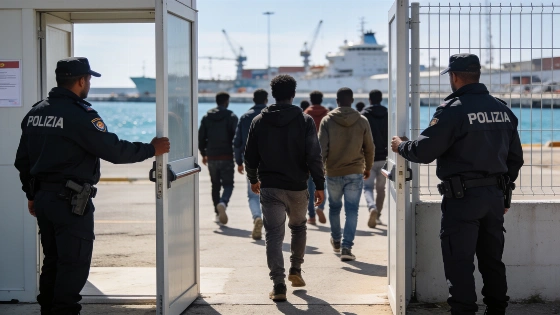
More than 3,000 migrants were moved from Ceuta’s beaches to a temporary reception centre at the port on Friday, 18 September. Alberto Núñez Feijóo accused the Government of losing control of public order. Hundreds of police officers took part in the operation, which became tense when some migrants broke through the cordon. Reuters reported that the new facility had accommodation for about 1,700 people. That helps explain why entry was managed in groups and why capacity quickly became a central issue. Against this backdrop, the PP leader promised a new security plan for Ceuta and Melilla if he becomes president.
The proposal would include physical borders and a larger presence of Spain’s security forces. Feijóo also called for the country’s borders to be placed under guaranteed protection. He argued that the people involved were not arriving to seek employment but to confront public order and the State security services.
Reuters reported that the temporary port facility had been prepared for approximately 1,700 people, even though more than 3,000 migrants were moved from the beaches during the operation.
Feijóo’s position is uncompromising.
He said the response should be the expulsion and return of all irregular migrants. He linked that demand to an agreement reached the previous day by the European Parliament and to Morocco’s stated willingness to accept returns. On 17 September, the European Parliament called for stronger protection of the EU’s external borders and faster returns of people without the right to remain, while stressing that such measures must comply fully with EU and international law. Feijóo made those remarks before meeting civil society organisations in Melilla, after witnessing the disorder surrounding the transfer.
The relocation began at around 7:00 in the morning. Some 170 Policía Nacional officers took part, including members of the UIP, drone technicians and personnel from different units. Another 70 agents from the GRS and the USECIC were assigned to public-order and citizen-security duties.
The crisis followed a mass arrival in Ceuta at the end of July and the beginning of August. Hundreds of migrants subsequently spent weeks on beaches and streets in difficult conditions, prompting the authorities to create a temporary facility and move people into the port area.
Migrants staying at Benítez and Trampolín beaches moved along the seafront towards a service road behind the San Pablo warehouse and near the temporary facility. Authorities admitted groups of about one hundred people at a time so they could enter in an orderly way and be identified. The limited number of places prompted some migrants to push forward, and several ran through the security line.
The Government described the deployment as the largest migrant transfer operation since the mass arrival in the autonomous city at the end of July. It praised the work of the State security forces and said there were no incidents beyond the practical difficulties of moving hundreds of people who knew that capacity was limited.
The PP gave a sharply different account, describing the operation as chaotic. The criticism followed a decision by the Audiencia Nacional on Thursday rejecting a precautionary measure that would have suspended the construction of tents requested by the Sindicato Unificado de Policía (SUP). Reports on the legal dispute said the court’s position allowed the port site to be used temporarily after earlier political and legal objections, leaving the authorities to organise the transfer under urgent conditions.
The dispute concerns the way the transfer is understood. The Government presents it as reception and controlled relocation, while the opposition frames it as a border-security failure requiring a harder security model. Earlier reports on the city’s unrest, including the Ceuta crisis, help explain why the scenes at the port carry such political weight.
Feijóo’s plan remains a promise rather than an implemented measure. The transfer, by contrast, was a concrete operation carried out under heavy police protection. The PP had announced that he would travel to Melilla and then return to Ceuta on 21 September with a European People’s Party delegation led by Manfred Weber. The visits were presented as part of a European response to the crisis and a push for stronger border security. The Government has demonstrated its operational response, while the PP has turned the same scenes into an argument for physical borders, more forces and mass returns. On the facts available here, Ceuta’s immediate management still depends on police deployments and limited reception capacity. The opposition is offering a future security programme rather than a measure already in force.