The 2026 World Cup group stage is rapidly defining its knockout lineup. Several teams have secured their spots, while others face early exits. Key fixtures and the fate of Spain are now in focus.
The 2026 World Cup is entering a critical phase as the group stage races toward its conclusion. With several teams already assured of a place in the round of 32, the tournament's knockout bracket is beginning to take shape. The first confirmed fixture, South Africa versus Canada, is now set for June 28 at 21:00, highlighting the rapid pace at which the competition is moving from speculation to certainty.
Among the nations that have already secured qualification are Mexico, Switzerland, United States, Germany, Argentina, Canada, South Africa, Brazil, Colombia, and Morocco. These teams have either topped their groups or clinched second place, ensuring their continued presence in the tournament. Mexico and the United States, both host nations, were the earliest to guarantee advancement after strong performances in their opening matches. Argentina, Germany, France, Canada, Switzerland, Brazil, Colombia, and Morocco have since joined them in the next round.
On the other side, several teams have seen their World Cup hopes end prematurely. Haiti, Jordan, Tunisia, Turkey, Uzbekistan, Panama, Czech Republic, Qatar, and Iraq have all been mathematically eliminated following disappointing group stage results. Their early exits underscore the unforgiving nature of the competition at this stage.
Spain, meanwhile, stands on the verge of qualification. After a crucial win over Saudi Arabia and a draw with Cape Verde, Luis de la Fuente's squad is well positioned to advance, barring an unexpected turn of events. England, Colombia, and Ghana are also close to confirming their places in the knockout rounds, with decisive matches still to come.
Provisional pairings for the round of 32 are emerging, though many group outcomes remain unresolved. Current projections include Germany facing the best third-placed team from groups A, B, C, D, or F; the United States against a top third-placed team from groups B, E, F, I, or J; and Mexico awaiting a third-placed side from groups C, E, F, H, or I. Argentina is set to meet the second-placed team from Group H, while Brazil will play the runner-up from Group F. The confirmed South Africa-Canada clash is the first fixture locked in for the next stage.
This World Cup's expanded format introduces a new dynamic: eight of the best third-placed teams will also progress to the knockout phase. FIFA's criteria for ranking these teams include points, goal difference, goals scored, fair play, and, if necessary, a draw. As a result, every goal and card in the final group matches could prove decisive, with teams closely monitoring parallel fixtures and calculating their chances until the last whistle.
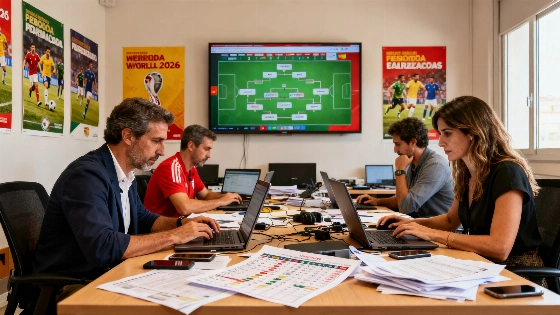
The knockout bracket remains fluid, with each match capable of reshaping the tournament's path to the final in New York. A single late goal can alter group standings, affecting the routes of favorites such as Argentina, France, Germany, or Spain. The official graphics and projections are being updated in real time as results come in, reflecting the ongoing uncertainty and drama of the group stage.
Key dates for the remainder of the tournament are already set: the round of 32 will run from June 29 to July 4, followed by the round of 16 from July 4 to 7, quarterfinals from July 9 to 12, semifinals on July 14 and 15, the third-place match on July 18, and the final at MetLife Stadium in New York/New Jersey on July 19. From the knockout stage onward, there will be no room for error, with each team knowing exactly how many matches separate them from the World Cup trophy.
While the focus is now on football, the unpredictability of major sporting events remains a constant. As seen in other international competitions, such as the recent return of the Brno circuit to the MotoGP calendar, unexpected developments can quickly shift the narrative and standings. For more on how sudden changes can impact major tournaments, see this analysis of the Czech Grand Prix's effect on MotoGP rankings: how the Brno circuit's comeback shook up the MotoGP standings.
For context, the 2026 World Cup is the first to feature 48 teams, expanding the group stage and increasing the number of knockout fixtures. The inclusion of best third-placed teams adds complexity to qualification scenarios, making the final group matches more consequential than ever. The tournament's structure ensures that no group is decided until the last match, keeping fans and teams alike on edge as the path to the final narrows.