Richart Sowa built a three-storey house on a floating island made from over 100,000 plastic bottles near Isla Mujeres. After storms and a government order, the unique structure was removed. His new project in Brazil remains unfinished.
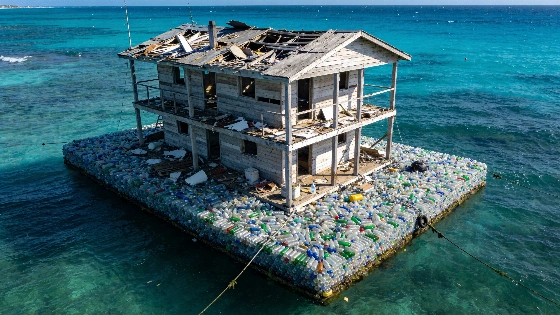
In early 2019, local authorities ordered the removal of Joysxee Island, ending one of the more unusual experiments in upcycling: a three-storey home floating on a base of more than 100,000 plastic bottles. British artist Richart Sowa had kept the structure afloat for years off Isla Mujeres, Mexico, weathering storms and attracting curious visitors, until it was finally dismantled and disappeared from the coast.
Sowa’s project was more than an art piece. By 2008, he had finished building a livable island using bottles packed into produce netting, stacked up to five meters thick. On top, he constructed a multi-level house, planted crops, set up solar panels, and even rigged a wave-powered washing machine. His aim was to show that waste could support self-sufficient living. Atlas Obscura reported the island was gone by January 2019, after storm damage and removal by local officials. Despite viral reports in 2026, Joysxee Island is not a current project but a completed and now-vanished experiment.
The reality was less ideal than the vision. Joysxee Island drew tourists and eco-minded travelers, but its full autonomy was never independently verified. Solar panels and rainwater collection were in place, but no outside study confirmed the island was truly self-sufficient. Sowa said the mangrove roots he planted helped hold the structure together and clean the water, but these claims were not tested by third parties. Independent research notes that the island's promised autonomy was never conclusively demonstrated.
The number of bottles used shifted in reports. A 2011 Kickstarter campaign listed 125,000 bottles as the core of the platform, while other sources mentioned anywhere from 100,000 to 150,000. The 125,000 figure from the 2011 fundraising effort is the best-documented, though no independent audit was ever done. As the island grew, more bottles may have been added, but no final count exists.
Joysxee was Sowa’s second floating bottle island. His first, Spiral Island, was destroyed by Hurricane Emily in 2005. After that loss, he rebuilt with a larger design. Visitors could reach Joysxee by a barge—also made from bottles—that could carry eight people. The project was compared to other recycled plastic efforts, like a greenhouse in Canberra built from 2,000 bottles and a Costa Rican house made with seven tonnes of plastic. Unlike those, Sowa’s bottles stayed whole and served as flotation, not building material.
The end came from a mix of storm damage and official action. Sowa said local authorities dismantled and removed Joysxee Island while he was out of the country. No municipal resolution has surfaced to explain the legal basis for the removal, so most details come from those directly involved. By January 2019, Atlas Obscura had updated its records to note the island no longer existed.
After losing Joysxee, Sowa turned to Brazil. The Bottland Foundation now promotes Trashure Island, a new floating project on a river near Itacaré. Plans call for housing up to 20 residents and 100 daily visitors, with hydroponic gardens and solar power. As of September 2026, the project is unfinished, fundraising has stalled, and there is no independent confirmation that the infrastructure is working or open to the public.
Joysxee Island is now a vanished experiment—an idea that briefly became reality before being undone by weather and bureaucracy. The Mexican structure is gone, surviving only in photos and memory. Sowa’s efforts in Brazil remain in the planning stage, with no evidence yet that his vision of a sustainable floating community has been realized. The lesson is clear: creative environmental projects can inspire, but without solid engineering and institutional support, even the most inventive solutions can disappear as quickly as they arrive.