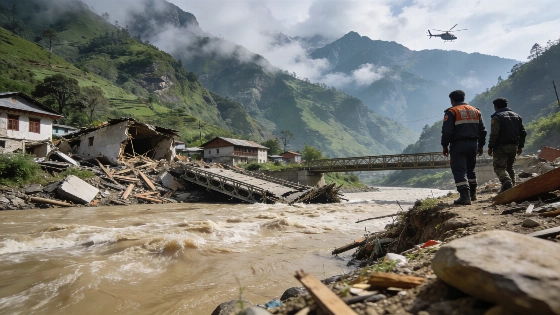
A sudden flood in Nepal's Gorkha province swept away about 40 homes and several bridges. Five people are missing, while helicopters search and officials warn downstream residents to evacuate.
The river rose 8.4 metres in a matter of hours in Nepal's Gorkha province. About 40 homes and several bridges were reportedly swept away, while five people remain missing. The incident struck the same wider region still struggling with the aftermath of Nepal's devastating August disaster.
The Kathmandu Post reported that Jagat-Bagar was among the worst-hit settlements. Salleri was also affected. So was Ghattikhola, in the Chumnubri rural municipality.
The river burst its banks at around 5:55 in the morning local time, equivalent to 02:10 in Barcelona. Preliminary information indicates that snow and mud, mixed with other debris, slid into the river near Chumnubri. The material blocked the Budhi Gandaki before accumulated water surged downstream.
The flood swept away homes in Jagat-Bagar, Salleri and Ghattikhola, while the current also engulfed a shelter near the Ungilung River in Chumchet, where five people were reported missing.
Six people have already been rescued by helicopter. The Nepal Army evacuated them from Jagat, where the danger of further landslides remained high. Military and police teams were sent into affected areas to search for people and assess the damage.
Prime Minister Balendra Shah said several helicopters had been deployed to search for those still unaccounted for. No deaths had been reported at the time of the latest information. Rescue teams were working across three settlements after the flood dragged buildings into the current, according to Narayan Prasad Sapokta, the administrative director of the Chumnubri rural municipality.
Reports also said that a hydropower project camp was damaged. An automobile bridge linking Gorkha with neighbouring Dhading was destroyed.
Authorities sent about 200,000 early-warning messages to residents in districts exposed to further flooding. Dharmendra Kumar Mishra, Gorkha's senior district official, urged people living along downstream riverbanks to leave immediately and move to safer ground.
Nepal's National Disaster Risk Reduction and Management Authority warned residents in Gorkha. The warning also covered Tanahun, Chitwan, East Nawalparasi and West Nawalparasi. Videos circulating on social media show houses and makeshift structures being carried between steep mountain slopes.
The danger was not limited to the immediate flood zone: authorities urged residents along the Budhi Gandaki and the connected Trishuli corridor to move to higher ground as the surge travelled downstream. The warnings covered Gorkha, Tanahun, Chitwan, East Nawalparasi and West Nawalparasi.
The suspected blockage occurred on the Budhi Gandaki, one of the tributaries feeding the Trishuli farther downstream. That geography links the new emergency to the catastrophe of August, when a glacier collapse triggered a flood that killed 1,457 people, with thousands still missing.
The earlier disaster affected areas that included Gorkha. Damaged roads and bridges obstructed aid delivery and movement through remote communities.
A local resident told the press that a powerful rumble woke people before dawn and prompted them to run uphill. Some residents reached higher ground in time. Others were caught inside hotels as they slept. The account points to the central danger of this flood: the river rose after a sudden obstruction rather than through a slow increase in water that people could easily observe.
Nepal's government had announced that search and rescue operations linked to the August catastrophe would end more than a month later, with attention shifting to reconstruction. Roads and bridges were the immediate priorities, especially in remote areas where destroyed infrastructure had complicated transport and aid distribution.
The new flood placed rescue work alongside that unfinished recovery. Mountain communities remained exposed when a blocked channel could send a destructive surge downstream.
The warning system worked quickly enough to trigger a mass evacuation alert. The loss of homes and bridges showed how little protection existed once a river was blocked above a settlement. The latest flood unfolded inside a region where rescue routes and basic infrastructure were already damaged.
Earlier flood alerts show how rapidly authorities can shift from monitoring water levels to ordering evacuations. In Gorkha, that shift came after the 8.4-metre rise, and five missing people remain the immediate measure of the disaster's human cost.